

The lid is the first thing you touch every time you reach for an acrylic case. Pick the wrong one and your acrylic display box feels awkward to open, lets in dust, or simply looks off on the shelf. Pick the right one, and it protects your items, looks clean, and works for years. It is one of the biggest decisions in any display box, yet it is easy to overlook until a problem shows up.
If you have ever shopped for a display box online, you have probably stared at three options and wondered which is best. Magnetic, sliding, and hinged all sound fine on paper, but each one behaves differently in real use. Here is a plain-language breakdown of these lids for display cases, so you can decide with confidence instead of guessing.
This guide is written for two readers: collectors who want one well-made case for a prized item, and wholesale buyers who order dozens or hundreds at a time for retail. The questions are the same, but the answers change a little when cost, MOQ, and shipping come into play. We will cover how each lid works, its pros and cons, the best use cases, and the practical buying details that most articles skip.
In a nutshell:
● Magnetic lids — clean look, quick open and close, best for light daily access.
● Sliding lids — no extra space needed, great for stacking on shelves.
● Hinged lids — secure and sturdy, ideal for high-value collectibles.
Why the Lid Design Matters
A display box does two jobs: protect what is inside and show it off. The lid carries most of that weight. A poorly matched lid type can damage your items, annoy your customers, or raise your packaging cost without adding value.
For B2B buyers and retail brands, the choice also affects production time and MOQ. The good news? Once you understand how each lid behaves, the decision becomes simple.
Magnetic Lid Acrylic Collectible Case

A magnetic lid uses small magnets embedded in the acrylic to hold the lid closed. There is usually no visible hinge or latch, so the box keeps a clean, seamless look.
Pros
● Minimalist appearance with no visible hardware.
● Fast and quiet to open and close.
● Simple to assemble, which often keeps cost down.
Cons
● Holding force is limited — a sharp knock can pop the lid open.
● Not ideal for oversized or heavy lids that need a strong seal.
● Magnet placement must be engineered, adding a small design step.
Best collectible use cases
● Trading card boxes, Funko-style figures, and small props.
● Retail displays where buyers open the case often.
● Cases that sit on shelves and are picked up frequently.
If your items are light and your audience opens the case daily, a magnetic lid acrylic collectible case is usually the smoothest option.
When to pick magnetic
● You want the cleanest, most modern look with zero visible parts.
● Your collectibles are lightweight, like cards, pins, or small figurines.
● The case will be opened and closed many times a day.
When to avoid it
● The lid is large or heavy, and you need a very firm seal.
● The case may be knocked or moved often, and popping open is a real risk.
● You need tamper-resistant protection for high-value pieces.
Magnetic lids also work well for gift-style packaging because opening feels satisfying. If brand experience matters, this is a strong option to consider for your display case.
Sliding Lid Acrylic Collectible Case
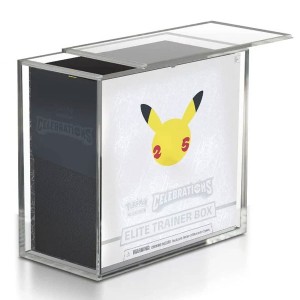
A sliding lid moves along grooves built into the box. It does not swing outward, so it works well where space is tight or where cases are stacked close together.
Pros
● Requires no extra clearance to open.
● Cases can sit flush against each other on a shelf.
● Fewer moving parts than a hinge, so little to break.
Cons
● Dust can settle in the slide track over time.
● The track may scratch if tolerances are off.
● Needs precise manufacturing to slide smoothly.
Best collectible use cases
● Cabinet and shelf displays where space is limited.
● Thin, wide cases such as coin or card organizers.
● Wholesale display box runs that need consistent, simple assembly.
Choose a sliding lid when you care more about stacking and saving space than about a tight seal.
When to pick sliding
● Cases sit on tight shelves or in closed cabinets with little clearance.
● You want to stack boxes close together without lids colliding.
● You need a simple, durable mechanism for repeat orders.
When to avoid it
● The environment is dusty, and you cannot clean the track often.
● Your collectibles are fragile and need a fully sealed, protected closure.
● The box is very deep, and the lid track adds too much height.
Sliding lids are a smart pick for card and coin collections, where the box is thin and stacked. Just confirm the track tolerance with your supplier so the lid stays smooth.
Hinged Lid Acrylic Collectible Case

A hinged lid is attached along one edge, either with an acrylic hinge or a metal hinge. It opens like a book and often includes a latch or clasp for a firm closure.
Pros
● Strong, secure closure that protects high-value items.
● Can stay open on its own, good for tabletop display.
● Easy to add a latch for extra safety.
Cons
● Hardware is visible, which changes the clean look.
● Needs extra space to swing fully open.
● Usually higher cost and a bit heavier to ship.
Best collectible use cases
● Museum-style display of fragile or expensive pieces.
● Large or heavy display box sizes.
● Long-term storage where the lid stays closed most of the time.
For security and durability, a hinged lid is the workhorse choice.
When to pick hinged
● You protect expensive, fragile, or irreplaceable collectibles.
● The box is large and heavy, and a strong hinge holds it best.
● You want the option to add a latch or clasp for extra safety.
When to avoid it
● Display space is tight, and the lid cannot swing fully open.
● You want a completely seamless look with no visible hardware.
● Weight and shipping cost are major concerns for your budget.
Metal hinges are stronger than acrylic ones and last longer, but they add visible hardware and cost. If you plan a display where the case stays closed, a hinged acrylic display case lid gives the best long-term protection.
If your pieces are fragile or stored long-term, the security of a hinged acrylic display case lid is worth the extra cost.
Quick Comparison: Magnetic vs Sliding vs Hinged
Here is a side-by-side view so you can scan the differences fast.
|
Consideration
|
Magnetic Lid
|
Sliding Lid
|
Hinged Lid
|
|---|---|---|---|
|
Best for
|
Light cases, frequent opening
|
Tight shelves, stacking
|
High-value, heavy items
|
|
Security
|
Moderate — can pop open
|
Good seal if tolerance is right
|
High — latch adds safety
|
|
Space to open
|
None needed
|
None needed
|
Needs swing clearance
|
|
Look
|
Cleanest, seamless
|
Neat, no swing hardware
|
Hardware visible
|
|
Typical cost
|
Low–mid
|
Mid
|
Higher
|
|
Shipping weight
|
Light
|
Light
|
Slightly heavier
|
|
Lid type note
|
Easy to assemble
|
Needs precise track tolerance
|
Strongest long-term hold
|
Five Quick Questions to Narrow It Down
Instead of overthinking, answer these, and the right lid type usually appears by itself.
1. Will the case sit on open shelves or inside closed cabinets?
2. How often will people open it to take items out?
3. What is the size and weight of the box?
4. Is a tight seal or anti-pop-open a priority?
5. Are you buying for retail resale, museum display, or personal collection?
A note on quantity
For a single case, any of the three works, and personal preference wins. For a bulk order, production cost and MOQ matter more. Magnetic and sliding lids are usually easier to scale, while hinged lids with metal parts can push up both cost and minimum quantities. Factor this into your plan early, and you will avoid surprises at the quoting stage.
Common Mistakes When Choosing a Lid Type
Most problems come from matching the wrong lid to the wrong situation. Avoid these four.
● Using a magnetic lid on oversized or heavy boxes — the magnet cannot hold the weight.
● Picking a sliding lid for fragile, high-value items — dust and scratches become a risk.
● Choosing a hinged lid for tight retail shelves — it cannot swing open.
● Ignoring shipping cost — hinged lids weigh more and add packaging bulk.
Beyond these, one more mistake deserves a mention: choosing purely on looks. A seamless magnetic lid photographs beautifully, but if your customer needs a secure, latched box, that clean look does not solve the real problem. Match the function first, then the style. Your supplier can often suggest a lid type that balances both.
Buyers often ask us the same thing before they order. Here are the questions we hear most.
FAQ

Can I mix lid types in one order?
Yes. Many manufacturers, including JAYI Acrylic, can run magnetic, sliding, and hinged lids in the same order as long as the box size and quantity are confirmed first. This is common for brands that sell a few product lines. Mixing works best when each lid uses the same box dimensions, so the factory can plan the material and tooling in one run.
Which lid is fastest to produce?
Magnetic and sliding lids generally move faster because they have fewer parts and simpler assembly. Hinged lids with metal hardware take a little longer, since the hinge must be attached and aligned carefully. Ask your supplier for a lead time quote on your chosen lid. For a tight deadline, a magnetic or sliding acrylic display case lid is often the safer bet.
Can you add a latch to a magnetic or sliding lid?
Yes. A magnetic lid can be reinforced with a stronger magnet or a small clip, and a sliding lid can be locked with a tiny catch. If you need extra security, tell the factory during the design stage so the groove and edge are made to fit. This is a good middle ground when you want a clean look but still need to keep the case closed.
What is the minimum order for custom acrylic collectible cases?
MOQ depends on size and lid. Simple acrylic display case lids usually start lower, while hinged or metal-hardware versions may need a larger run to stay cost-effective. Request a quote with your dimensions and target quantity to get an exact number. Most factories give clearer pricing when you share both the box size and the lid up front.
Are hinges and magnets replaceable if damaged?
Generally yes. Spare hinges and replacement magnets can be supplied or shipped separately, so a damaged unit does not force a whole re-order. It is worth confirming spare parts availability before you commit to a bulk order, and asking how quickly spares can be dispatched if a customer reports an issue.
How do I make sure the lid ships safely?
Hinged lids should be packed with the box protected at the hinge point, since that is where stress concentrates in transit. Magnetic and sliding lids are more forgiving, but all three benefit from corner protection on the lid area. Ask for protective packaging and, for fragile items, add foam or bubble wrap around the edges so the case arrives in the same condition it left the factory.
Final Recommendation
There is no single best lid — only the best lid for your situation.
● Pick a magnetic lid if you value a clean look, open the case often, and store light items.
● Pick a sliding lid if space is tight, cases are stacked, and a good seal matters.
● Pick a hinged lid if you protect high-value or heavy collectibles and want a firm, secure close.
Still unsure? Send your box dimensions and what you plan to store, and we will recommend the right acrylic collectible case lid for your project.

JAYI Acrylic is a custom acrylic display case manufacturer and OEM/ODM supplier with over 20 years of experience. We help brands and wholesalers around the world choose the right lid type, confirm MOQ and samples, and ship cases that are made to last.
Our factory handles the full range of acrylic display case lids — magnetic, sliding, and hinged — and can advise on material thickness, hardware options, and packaging so your product arrives intact. Whether you need a single well-built case or a large production run, our team treats every order with the same attention to quality.
Send us your design, your collectible type, and your target quantity. Our team will reply with a recommendation, a sample plan, and a clear quote. We can also discuss finishes, engraving, and branding so the case matches your product line.
Contact sales@jayiacrylic.com for your custom acrylic collectible display case project.

Cathy Qin works at Jayi Acrylic Industry Limited, focusing on custom acrylic product management and SEO-driven content marketing for B2B wholesale and retail applications. Her work includes designing display solutions, managing customization projects, and optimizing website content to promote Jayi’s high-quality acrylic products across global digital channels.
Post time: Oct-20-2026