
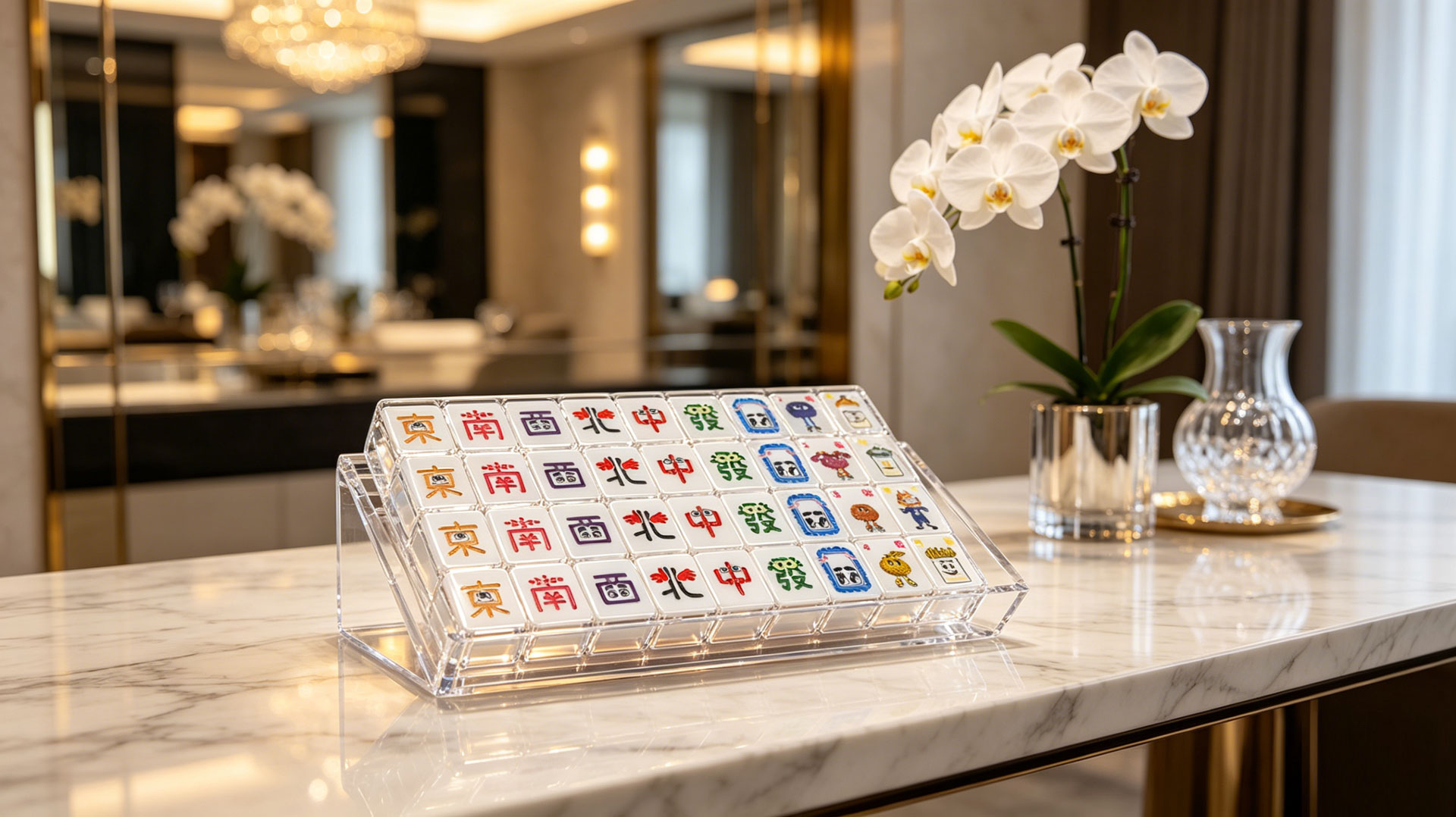
Off-the-shelf American mahjong sets serve players, but they don't serve brands. For distributors and retailers building a differentiated product line, custom mahjong tiles design is the mechanism that turns a generic set into a proprietary design — one that cannot be price-matched by competitors. This article maps every customization layer available for custom American mahjong tiles, from logo application through packaging, so you can specify exactly what you need before requesting a sample.
Key Points:
• Logo application technique (laser engraving, UV printing, embossing) determines durability, visual depth, and per-unit cost — each suits different brand positioning
• Layered acrylic construction enables color-through tile bodies that resist fading and wear, unlike surface-only printing
• Full-color customization starts with Pantone matching at the acrylic sheet level, not post-production paint
• Tile face character redesign accommodates brand-specific symbols, bilingual layouts, or NMJL-compliant variations
• Packaging customization aligned with tile design creates a cohesive retail product rather than a generic set in a branded box
Why Custom Design Matters for American Mahjong Brands
A custom-designed American mahjong set accomplishes two things that a stock product cannot. First, it creates visual distinction on the shelf and in online listings — where most purchasing decisions begin. Second, it embeds your brand identity into the product itself, not just the packaging that gets discarded after purchase.
The customization scope for American mahjong tiles is broader than most buyers assume. Beyond adding a logo, you can modify tile body color, layer structure, face symbol design, edge treatment, and packaging — each layer contributing to a product that competitors cannot replicate by sourcing from the same factory. Understanding these options helps you make informed trade-offs between design ambition, production complexity, and unit cost.
Logo Application Techniques
Logo placement on American mahjong tiles involves three primary techniques, each with distinct visual characteristics, durability profiles, and cost implications. The right choice depends on where the logo appears, how visible it needs to be, and what handling conditions the tiles will endure.
Laser Engraving
Laser engraving removes a thin layer of acrylic material to create a recessed mark. The engraved area contrasts with the surrounding surface through light diffusion, producing a frosted or subtly darkened appearance depending on the acrylic color. For dark tiles (green, blue, black), the engraving appears as a lighter mark; for light tiles (white, ivory), it appears slightly darker.
This technique is ideal for logo placement on tile backs where durability is critical. Because the mark is cut into the material rather than applied on top, it cannot peel, fade, or rub off under normal play conditions. Engraving depth is typically 0.2–0.5mm — enough to be visible and tactile without weakening the tile structure.
At JAYI Acrylic, laser engraving is our default logo method for custom tile backs because it produces a permanent brand mark with zero consumable cost and minimal setup time. A CNC program change is all that separates one client's logo from another's.
UV Printing
UV printing applies ink cured instantly by ultraviolet light, producing full-color graphics on the acrylic surface. This is the only technique that supports multi-color logos, gradients, or photographic images on mahjong tiles.
The cured ink layer bonds tightly to the acrylic and resists normal handling, though prolonged abrasion (such as tiles scraping against each other in a bag) can eventually degrade the print over years of play.
UV printing is best suited for tile backs where color accuracy matters more than extreme wear resistance, and for case or rack surfaces where the logo is decorative rather than functional.
Embossing
Embossing creates a raised relief by integrating the logo into the tile surface during production — either through a custom mold insert or by bonding the logo element between acrylic layers during the layered construction process. The result is a three-dimensional mark that is both visual and tactile.
Embossing requires dedicated tooling, which adds upfront cost and lead time for the first order. However, the tooling is reusable across production runs, making embossing cost-effective for brands with stable designs and reorder volume. The raised surface also resists wear better than surface printing, since the logo is part of the tile body rather than applied to it.
Technique Comparison
| Technique | Visual Effect | Durability | Best Placement | Cost Impact |
|---|---|---|---|---|
| Laser engraving | Recessed mark with frosted or darkened contrast | Permanent — engraving cuts into the acrylic surface | Tile back, rack, case interior | Low — no consumables; setup by CNC program |
| UV printing | Full-color, high-resolution surface print | Good — resistant to handling; can wear under extreme abrasion | Tile back, packaging, case exterior | Medium — per-color setup; color count affects cost |
| Embossing (in-mold) | Raised relief integrated into the tile surface | Permanent — formed during tile molding or layer bonding | Tile back logo, decorative edge detail | Higher — requires a custom mold or tooling insert |
Layered Acrylic Construction and Color Customization
How Layered Acrylic Mahjong Tiles Are Built
American mahjong tiles produced with layered acrylic construction consist of two or more acrylic sheets bonded together — typically a colored body layer and a white face layer. The face layer is cut away at engraved or printed symbol positions, revealing the body color underneath. This construction method is what gives high-quality acrylic mahjong tiles their characteristic color-through depth.
Layer Structure Options
| Layer Config | Construction | Visual Result | Typical Use |
|---|---|---|---|
| 2-layer | Colored body + white face | White symbols on a colored background; symbols visible through the engraved depth | Standard American mahjong sets |
| 3-layer | Colored body + white face + transparent cap | Extra depth; symbols appear to float beneath a clear surface | Premium product lines |
| Inlay | Colored body with inlaid symbol material | Symbols in contrasting colors set into the tile face | High-end or decorative sets |
Color Customization at the Material Level
Full color customization begins at the acrylic sheet level, not as a post-production paint or coating. JAYI produces custom-colored acrylic sheets formulated to match Pantone references, ensuring that your tile body color is consistent from the first production run through reorders years later. This material-level approach means the color runs through the entire tile — scratches, chips, and normal wear do not reveal a different underlying color.
Pantone Matching Process
| Step | Action | Deliverable |
|---|---|---|
| 1 | Client provides Pantone reference code(s) | Confirmed color target |
| 2 | The factory produces a sample acrylic sheet in the target color | Physical color sample for approval |
| 3 | Client approves or requests an adjustment | Signed color approval |
| 4 | Approved formula locked to client project | Consistent color across all future production |
Color matching tolerance is maintained within ΔE ≤ 2.0 — the threshold below which color difference is imperceptible to the unaided eye under standard viewing conditions. For brands with strict color standards (university licensing, corporate identity programs), this tolerance can be tightened to ΔE ≤ 1.5 with spectrophotometer verification on every production batch.
Themed Patterns and Tile Face Character Options
Themed Pattern Design
Themed patterns extend customization beyond the logo into the visual identity of the entire tile set. Common applications include:
• Seasonal or holiday editions: Custom mahjong tile back patterns aligned with cultural or seasonal themes
• Organization and club branding: Logos, crests, or insignia integrated into tile design elements
• Licensed character or motif sets: Artwork applied via UV printing or layered inlay for brand collaborations
For brands expanding a custom mahjong set product line, themed patterns can be coordinated across tile size variants (30mm, 35mm, 40mm) to create a unified visual family under the same brand umbrella.
Pattern application methods follow the same technique selection logic as logos: laser engraving for permanent single-color patterns, UV printing for multi-color artwork, and inlay for premium depth effects. Pattern complexity directly affects production time — intricate UV-printed designs with fine detail may add 2–3 days to the tile production phase compared to standard engraved patterns.
Mahjong Tile Face Character Customization
American mahjong tile faces carry specific characters and symbols defined by NMJL rules: the 152-tile set includes Craks, Bams, Dots, Winds, Dragons, Jokers, and Flowers. Within this framework, several customization options remain available:
| Customization | What Changes | NMJL Compliance Impact |
|---|---|---|
| Font style | Typeface of Crak characters, number style | No impact if characters remain identifiable |
| Bam/dot rendering | Artistic style of Bam sticks, Dot circles | No impact if count and orientation are clear |
| Dragon/wind symbol | Visual style of Red/Green/White Dragon, wind characters | No impact if symbol identity is unambiguous |
| Joker design | Full artistic freedom on Joker face (often used for brand logo) | No impact — Jokers have no standard symbol |
| Flower tile artwork | Decorative design on flower tile faces | No impact — flower tiles are not used in American mahjong play |
| Bilingual characters | Add secondary language text alongside standard symbols | Must not obscure or replace standard symbols |
The Joker tile is the most common canvas for brand customization because it carries no standardized symbol — your logo or artwork can occupy the full tile face without affecting game compliance. Flower tiles offer similar freedom for decorative customization.
Packaging Co-Customization
Why Packaging Should Be Designed with the Tiles
Packaging is not an afterthought — it is the first physical touchpoint your customer has with the product. A tile set with custom colors, logo, and themed patterns arriving in a generic brown box undermines the entire design investment. Packaging co-customization ensures the unboxing experience matches the product identity.
Packaging Customization Levels
| Level | Elements | Typical MOQ | Lead Time Add |
|---|---|---|---|
| Standard + label | Stock case with custom-printed sleeve or label | 100 sets | 0 days |
| Custom print case | Full-color printed case exterior, custom interior layout | 200 sets | 3–5 days |
| Full custom package | Custom case design, interior trays, insert cards, branded tissue | 300 sets | 5–7 days |
Case and Box Options for American Mahjong
American mahjong sets require larger cases than other game products due to the 152-tile count plus racks and accessories. Standard case formats include:
• Softcase with zipper: Lightweight, cost-effective; suitable for mid-range product lines
• Rigid acrylic case: Matches the tile material; premium positioning; can be laser-engraved or UV-printed
• Wooden or leather-look case: Traditional aesthetic; preferred for gift-oriented SKUs
Interior layout design should account for tile dimensions, rack count, and any accessory inclusions (betting chips, rule cards, pushers).
For brands offering acrylic board games alongside mahjong — such as domino or backgammon sets — coordinating packaging design language across product lines reinforces brand consistency at retail. JAYI produces acrylic mahjong racks sized to match custom tile specifications, ensuring a consistent fit within the case without loose movement that causes transit damage.
Specifying Your Custom Design Requirements
A complete custom design specification reduces sample revision rounds and accelerates time to production. The following checklist covers every design decision point:
Custom Design Specification Checklist
| Category | Specification Required | Typical Options |
|---|---|---|
| Logo | Technique, placement, size, file format | Laser engrave / UV print / emboss; tile back or case |
| Tile body color | Pantone reference or sample match | Any Pantone color; ΔE ≤ 2.0 standard |
| Tile face style | Font, symbol rendering, Joker design | Standard / custom font; themed Joker; bilingual |
| Tile size | Length × width × thickness (mm) | 30×22×12, 35×25×14, 40×28×16 (custom available) |
| Layer structure | 2-layer / 3-layer / inlay | 2-layer standard; 3-layer premium; inlay high-end |
| Tile back pattern | Pattern design, technique, coverage | Full-back/center medallion/border pattern |
| Edge treatment | Bevel, radius, or sharp | Beveled (standard), rounded (premium), sharp (not recommended) |
| Packaging | Case type, print design, interior layout | Softcase / rigid acrylic / wooden; custom print |
| Accessories | Rack style, pusher, betting chips, rule card | Matching or contrasting color; branded or generic |
| Compliance marks | NMJL rule card inclusion, safety labeling | Required for US retail; specify version |
File Format Requirements
Supply logo and pattern artwork in vector format (AI, EPS, or SVG) for laser engraving and embossing, or high-resolution raster (300+ DPI PNG or TIFF) for UV printing. Vector files allow precise CNC path generation without resolution loss; raster files must meet minimum pixel density at the actual print size.
FAQ
What logo technique is most durable for mahjong tiles?
Laser engraving produces the most durable logo because it cuts into the acrylic surface rather than applying material on top. The engraved mark cannot peel, fade, or rub off. Embossing is equally permanent but requires custom tooling. UV printing offers the broadest color range, but it can wear under extreme abrasion over extended use.
Can I customize the color of every tile in an American mahjong set?
Yes. Color customization is applied at the acrylic sheet level before tile cutting, so each tile body color is specified individually. Most custom orders use a single body color across all tiles for visual cohesion, but per-suit or per-rank color differentiation is technically feasible with appropriate MOQ.
How does Pantone color matching work for mahjong tiles?
You provide a Pantone reference code; the factory formulates an acrylic sheet in that color and produces a physical sample for your approval. Once approved, the color formula is locked to your project and applied consistently across all production runs, including reorders. Standard color tolerance is ΔE ≤ 2.0.
Can I change the characters on American mahjong tile faces?
Tile face characters must remain identifiable per NMJL rules for the set to be compliant with American mahjong play. Within that constraint, you can customize font style, artistic rendering of symbols, and the full design of Joker and Flower tiles. Bilingual additions are permitted if standard symbols remain unobscured.
What packaging options are available for custom mahjong sets?
Three levels: standard case with custom label (lowest MOQ), full-color printed case exterior with custom interior layout, and fully custom package design including case, trays, insert cards, and branded tissue. Case formats include softcase, rigid acrylic, and wooden or leather-look boxes.
How should I prepare artwork files for custom tile design?
Supply vector files (AI, EPS, SVG) for laser engraving and embossing — these generate precise CNC paths. For UV printing, provide high-resolution raster files at 300+ DPI at actual print size (PNG or TIFF). Include Pantone references for all colors. Avoid low-resolution JPEGs or web-optimized images, as these produce visible artifacts at production scale.
Conclusion
Custom American mahjong tile design covers multi-dimensional customization options, including logo crafting, layered acrylic structures, precise Pantone color matching, themed tile patterns, compliant face symbol adjustment, and branded packaging.
Each customization option balances visual aesthetics, product durability, production cost, and market compliance, helping brands create exclusive, non-replicable mahjong products distinct from generic wholesale goods.
With standardized design specifications and professional production processes, brands can launch high-quality, NMJL-compliant custom mahjong sets to stand out in the US retail market and build unique brand competitiveness.
Recommend Reading

Cathy Qin
Cathy Qin works at Jayi Acrylic Industry Limited, focusing on custom acrylic game product management and SEO-driven content marketing for B2B wholesale and retail applications. Her work includes designing display solutions, managing customization projects, and optimizing website content to promote Jayi’s high-quality acrylic products across global digital channels.
Post time: Jun-03-2026