
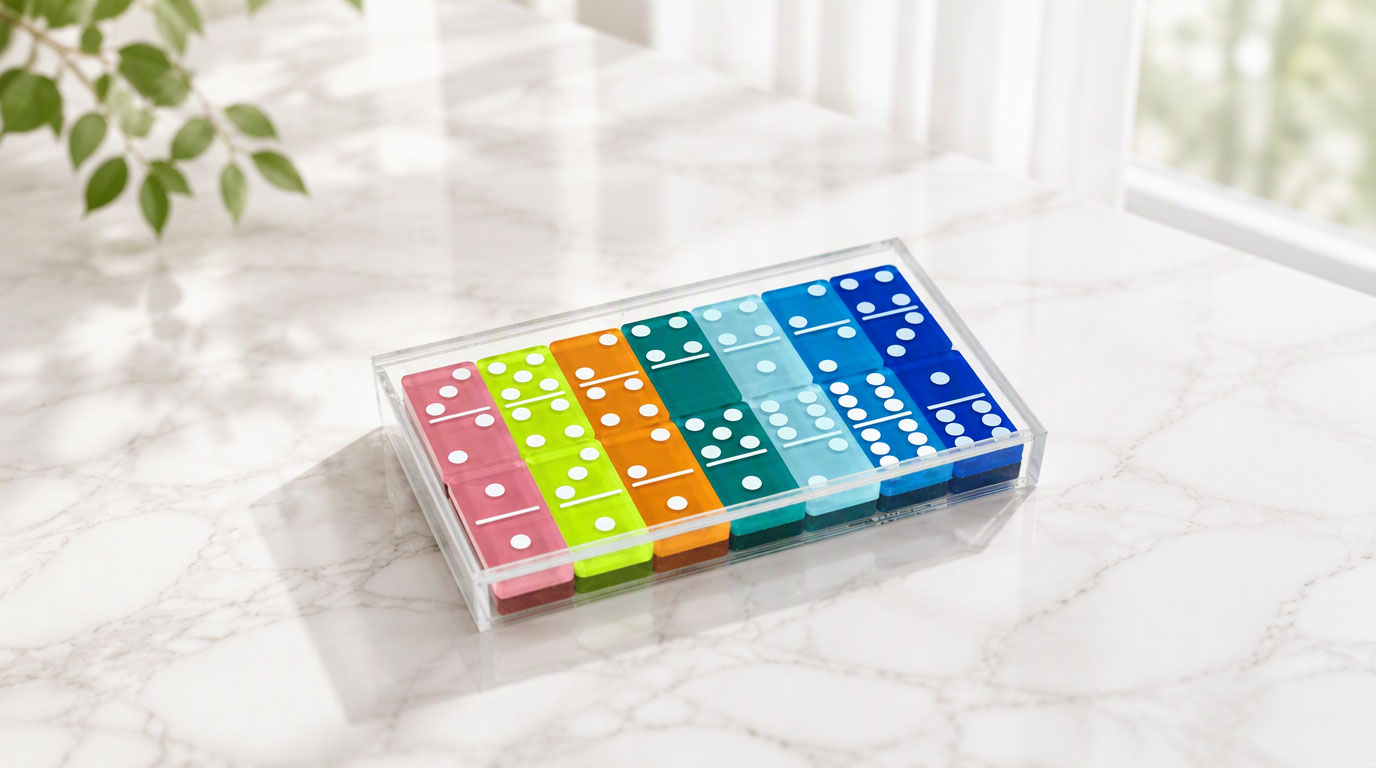
Buyers come to a custom acrylic domino set for a few clear reasons: they want a premium look that plastic sets cannot match, they want their own logo or colours on the tiles, and they want a product that feels weighty and lasts. Acrylic delivers on all three, which is why it keeps showing up in gifts, retail shelves and branded promotions.
But "custom" is a wide word. Before you ask for a quote, you need to know what you are buying. Tile size decides how the set feels in hand, thickness decides durability and weight, and the dot (or pip) standard decides how it is printed, engraved, and recognised as a real game piece. Nail these down and everything else — packaging, logo placement, pricing — gets much easier.
• Why it matters: getting these specs wrong means expensive rework or a set your customers send back.
• Who it helps: wholesale buyers, retail brands, gift companies, and anyone ordering dominoes in bulk.
Why Acrylic Dominoes Are Popular for Custom Orders
Acrylic is a favourite for custom domino orders because it is easy to shape, colour and decorate. Unlike wood, it is uniform in texture, so every tile in the batch matches. Unlike cheap plastic, it has a nicer weight and a clear, glass-like finish that photographs well — and a photo is what sells your listing.
It also handles logos well. You can engrave, print, or paint your brand on the tile, and the result stays sharp because the surface is smooth and non-absorbent. For a custom acrylic domino set that feels like a real product rather than a toy, acrylic is the practical starting point.
Key Spec 1 — Acrylic Domino Tile Size Options
Tile size is the first number a factory will ask about, and it drives almost every other decision. The size you choose sets the weight per set, the box dimensions, and the price. There is no single "correct" size — the right one depends on who is playing and where the set will be used.
Common acrylic domino tile sizes at a glance
45 mm · 1.77 in
55 mm · 2.17 in
60 mm · 2.36 in
70 mm · 2.76 in
85 mm · 3.35 in
100 mm · 3.94 in
Frequent play / everyday use
Balanced all-rounder
Gift & display focus
The chart above shows common sizes from a small travel set up to a large display piece. As a rule of thumb: smaller tiles suit travel sets and kids' games, standard sizes suit everyday family play, and larger tiles suit gifts, tournaments, and pieces meant to sit on a table and impress.
Standard Domino Dimensions
Most double-six domino sets sold today use a tile that is roughly 2.17 inches (55 mm) long, with a width of about 1.08 inches (27.5 mm). That ratio — the classic 2:1 length-to-width shape — is what most players expect, so factories can produce it quickly and cheaply.
Keep this baseline in mind: deviating from it is fine, but every change adds cost or lead time. If you are unsure what to pick for a first order, the 55 mm standard tile is the safe, sellable choice.
|
Tile size (length)
|
Metric
|
Inches
|
Best suited for
|
|---|---|---|---|
|
Mini / Travel
|
45 mm
|
1.77 in
|
Pocket games, gifts, kids
|
|
Standard
|
55 mm
|
2.17 in
|
Everyday family play, best default
|
|
Standard +
|
60 mm
|
2.36 in
|
All-rounder, balanced weight
|
|
Jumbo
|
70 mm
|
2.76 in
|
Tournaments, outdoor, seniors
|
|
Large / Display
|
85 mm
|
3.35 in
|
Gifts, showpieces, decor
|
Custom Size Modification & Production Limits
Most factories can cut an acrylic domino tile to any length and width you specify. The real constraint is the acrylic sheet they cut from — a tile cannot be larger than the raw sheet, and very thin or very long tiles become fragile. Your requested size should also match the number of tiles in the set, so the box can be sized cleanly.
Ask two questions when you request a custom size: (1) what sheet thickness is safe at this size, and (2) what the per-tile cutting tolerance is. This stops surprises where your 60 mm tile arrives as 59.4 mm.
How To Pick The Right Tile Size For Your Market
Think about who actually uses the set. A travel edition sells best in a compact size that fits a pocket. A premium gift set benefits from a larger tile because it looks like it is worth more. A tournament set needs a size and weight that feels good for hours of play.
• Retail/gift: go 60–85 mm so the set looks premium on camera.
• Budget/volume: stay on the 55 mm standard to keep the price competitive.
• Kids/travel: use 45 mm or smaller for easy handling.
Key Spec 2 — Acrylic Domino Thickness & Material
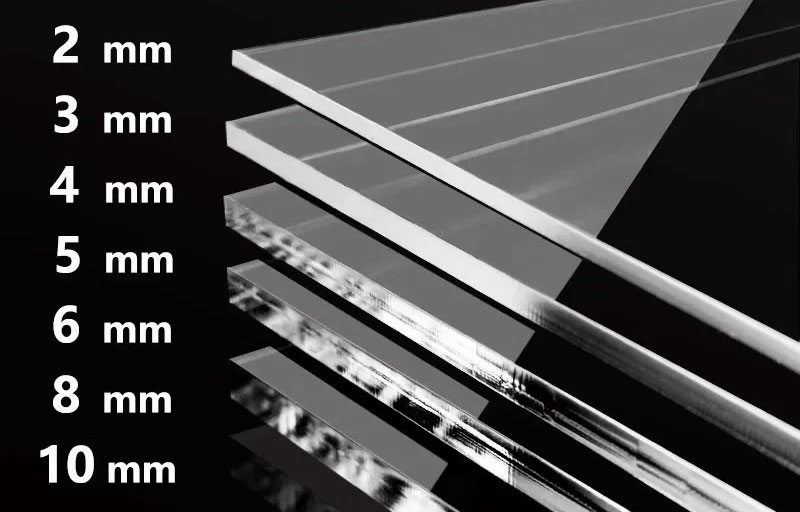
Thickness is the spec buyers most often forget, yet it changes how the set feels more than anything else. A thin tile feels cheap and flexes; a thick tile feels solid and expensive. Most acrylic domino sets are made from 3 mm to 5 mm sheets, with 3 mm being the most common for standard play.
|
Thickness
|
Common use
|
What it means for the buyer
|
|---|---|---|
|
3 mm
|
Standard sets
|
Good balance of weight and price; the usual default
|
|
4 mm
|
Premium/gift
|
Feels heavier, less likely to feel thin
|
|
5 mm +
|
Jumbo/display
|
Solid, premium weight; higher cost and shipping weight
|
Thickness Impact on Weight, Durability & Hand Feel
Thicker acrylic dominoes feel substantial, drop less easily from your hand, and resist bending over time. The trade-off is that more material means a higher unit cost and heavier cartons, which raises your freight bill. For a custom acrylic domino set sold online, 3 mm hits the sweet spot for most buyers.
If you are ordering jumbo or display tiles, step up to 4 mm or 5 mm. A large, thin tile looks flimsy no matter how well it is cut, so the thickness should scale with the size.
Acrylic Sheet Grade: Virgin vs Recycled Acrylic
Not all acrylic is equal. Virgin acrylic is clear, uniform, and free of specks, keeping that premium look. Recycled acrylic is cheaper but can carry colour streaks or small defects, which show up badly on light-coloured tiles.
For a branded custom acrylic domino set, ask for virgin material. It costs a little more but avoids customer complaints about cloudy or uneven tiles, and it photographs far better — which directly helps your product page convert.
Thickness Tolerance & Quality Control
You should agree on a thickness tolerance with the factory, usually plus or minus 0.1 mm. This sounds small, but a set where some tiles are 3.0 mm and others are 3.4 mm feels uneven in the hand and looks sloppy. Ask the factory to state its tolerance in writing before you approve the sample.
Key Spec 3 — Dot (Pip) Standard & Customization Methods
The dots on a domino are its language. Buyers do not always say "pips" — they say dots, points, or the numbers — but the standard matters because players recognise a set by it. A double-six set has tiles from 0-0 up to 6-6, and the dot layout follows a classic pattern most players expect.
For a custom order, you can keep the standard dot layout and simply change the colours, or you can go further and print your logo or a full design across the tile. Both are common, and both are produced by a few different methods.
Traditional Dot Colour & Size
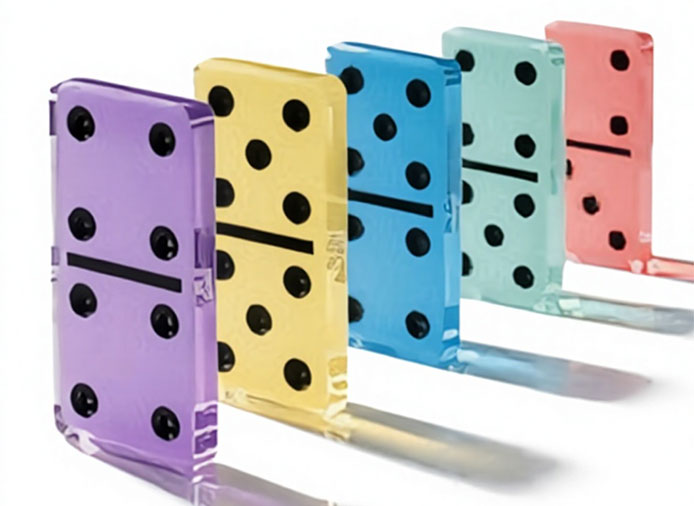
Classic domino dots are usually white on black, or black on white. On acrylic, the dots are most often printed or engraved in a contrasting colour so they stand out clearly. Dot size follows the tile: bigger tiles carry slightly bigger dots so the set stays readable from a distance.
Main Pip Making Techniques for Acrylic Domino
|
Technique
|
How it works
|
Best for
|
|---|---|---|
|
UV printing
|
Ink printed directly on the tile surface
|
Full-colour logos, photos, complex designs
|
|
Engraving
|
Dots or logo carved into the surface
|
Durable, premium look; dots can be filled with colour
|
|
Paint fill
|
Colour filled into engraved or recessed dots
|
Glossy contrast that resists wear
|
|
Screen printing
|
Ink pushed through a stencil
|
Simple dot colours at low cost
|
Custom Pip Options: Logo, Pattern & Brand Printing
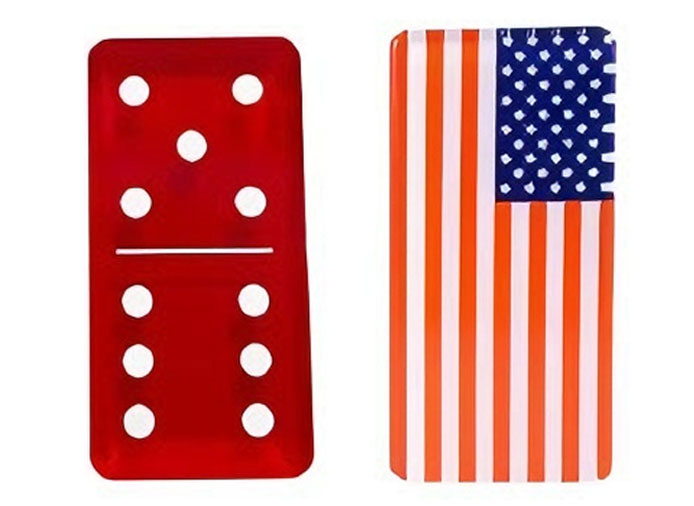
Because acrylic is smooth, almost any decoration works. You can print a full brand pattern across the back of the tile, engrave your logo in one corner, or replace the standard dots with branded dots. UV printing is the easiest way to add full colour and is the most popular for logo-heavy orders.
If your design will be engraved, confirm the dot and logo depth with the factory. Too shallow and it wears down; too deep and it weakens the tile. A good rule is to approve a pre-production sample before the full run, so the dot standard is locked exactly as you want it.
Other Customization Options for Acrylic Domino Sets
Once the three core specs are fixed, you still have room to make the set feel finished. These choices affect the look, the unboxing experience, and, importantly, the perceived value — which is what lets you price above a plain set.
Surface Finish: Gloss, Matte or Frosted
Gloss is the default and gives that glassy, premium shine. Matte hides fingerprints and scratches better. Frosted looks modern and softens the light. Pick the finish to match your brand: a luxury gift set often suits matte or frosted, while a clear, glossy set photographs the brightest.

Box & Packaging
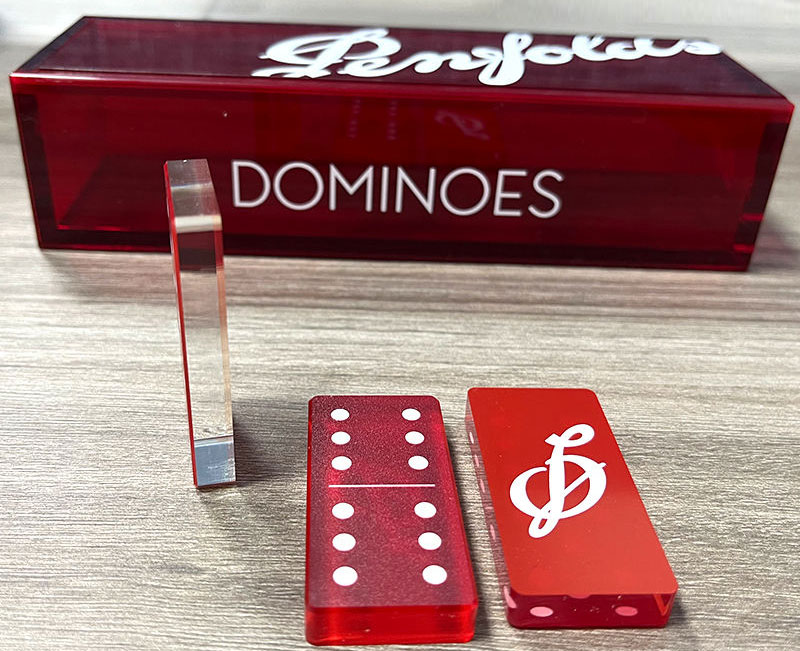
Your tiles can ship in a plain acrylic box, a wooden box, or a velvet tray, and the choice changes the unboxing feel and the shipping cost. A rigid box with dividers keeps tiles from shifting and is the safest for transit. If you want the set to feel like a gift, a wooden or velvet presentation box is a strong upsell.
Set Configuration
Double-six (28 tiles) is the standard and the most common order. Double-nine (55 tiles) and double-twelve (91 tiles) are bigger sets for longer games. The set size drives the tile count, the box size, and the weight, so confirm it early — it changes the whole bill of materials.
Compliance & Quality Checkpoints for Bulk Orders
Dominoes may seem simple, but a bulk order can hide real problems if you do not check. Two things matter most: material safety and consistency across the batch.
Material Certifications
If you sell into Europe or North America, your acrylic material should meet basic safety and chemical limits. Ask for RoHS, REACH, or SGS reports for the raw acrylic, and make sure any inks used are suitable for the target market. For children's products, additional toy-safety compliance may apply — confirm this early because it can add time and cost.
Common Defects To Check Before Shipment
• Uneven thickness — tiles should feel the same edge to edge.
• Scratches or clouding — more visible on light and clear tiles.
• Faded or misaligned dots — check the dot standard on several tiles.
• Sharp edges — edges should be polished, not rough.
Sample Approval Is Your Best Safeguard
Never skip the pre-production sample. It confirms that the acrylic domino tile size, thickness, and dot standard all match your spec, and it is far cheaper to fix one sample than a full container. Approve the sample in writing, then keep a copy as a reference for inspection.
FAQ

What is the MOQ for a custom printed acrylic domino set?
MOQ depends on the decoration method. Simple screen-printed or solid-colour sets often start at around a few hundred sets, while full-colour UV printing may carry a higher minimum because of setup. Ask the factory for its exact MOQ per decoration method before you commit, and confirm whether the sample cost is refundable against the order.
How long does production and shipping take?
A typical bulk order takes a few weeks for production after sample approval, plus transit time that depends on your destination and shipping method. Air freight is fast but costs more; sea freight is cheaper but slower. Always add a safety margin for your own launch date.
Can I mix different tile sizes or set sizes in one order?
Yes, in most cases. Mixing a travel size and a jumbo size in one order is common, but each combination is priced separately and may need its own tooling or setup. It is usually most cost-effective to keep the number of different specifications small.
Will the printed logo wear off with use?
It depends on the method. Engraved or paint-filled dots last the longest because they sit in the material. UV printing on top of the tile can wear off with heavy use unless it is protected. If durability matters, tell the factory you want an engraved or recessed finish.
What should I do if the batch arrives with defects?
Agree on the inspection terms before production, not after. A clear AQL (acceptable quality limit) and a photo-based defect list mean both sides know what is acceptable. If defects show up, a reliable factory will replace the faulty tiles — that is exactly why you keep your approved sample as a reference.
Do you help with custom box and packaging design?
Most custom domino factories do. They can advise on box size, material, and insert layout, and many produce the packaging too. Bringing packaging into the same factory saves coordination and often lowers cost, so it is worth asking up front.
Final Tips Before You Place Your Custom Domino Order
By now you have the three specs that decide everything: acrylic domino tile size, thickness, and dot standard. Before you sign, run this short checklist.
• Confirm the size and thickness in writing, including the tolerance.
• Lock the dot standard — colours, layout and logo placement.
• Approve a pre-production sample and keep it as your reference.
• Agree the MOQ, lead time and AQL before production starts.
• Confirm certifications for your target market early.
Getting these details right on the first order saves you time, money, and returned goods. When the factory knows exactly what you want, you get a cleaner product, a smoother process, and a supplier you can reorder from for years.
Conclusion
Ordering a custom acrylic domino set comes down to being specific.
Choose a tile size that fits how the set will be used, a thickness that feels premium without blowing your budget, and a dot standard that prints or engraves cleanly with your brand.
Pair those with an approved sample and clear inspection terms, and your order is set up to succeed.

We are JAYI Acrylic, an acrylic manufacturing factory that has been making custom acrylic board game products since 2004.
We help wholesale buyers and retail brands specify the right tile size, thickness, and dot standard, and we handle the sample, production, and packaging under one roof.
If you are planning a custom acrylic domino set and want a quote or a sample, reach out to us at sales@jayiacrylic.com — we are happy to recommend the specification that fits your market.

Cathy Qin works at Jayi Acrylic Industry Limited, focusing on custom acrylic product management and SEO-driven content marketing for B2B wholesale and retail applications. Her work includes designing display solutions, managing customization projects, and optimizing website content to promote Jayi’s high-quality acrylic products across global digital channels.
Post time: Oct-17-2026