
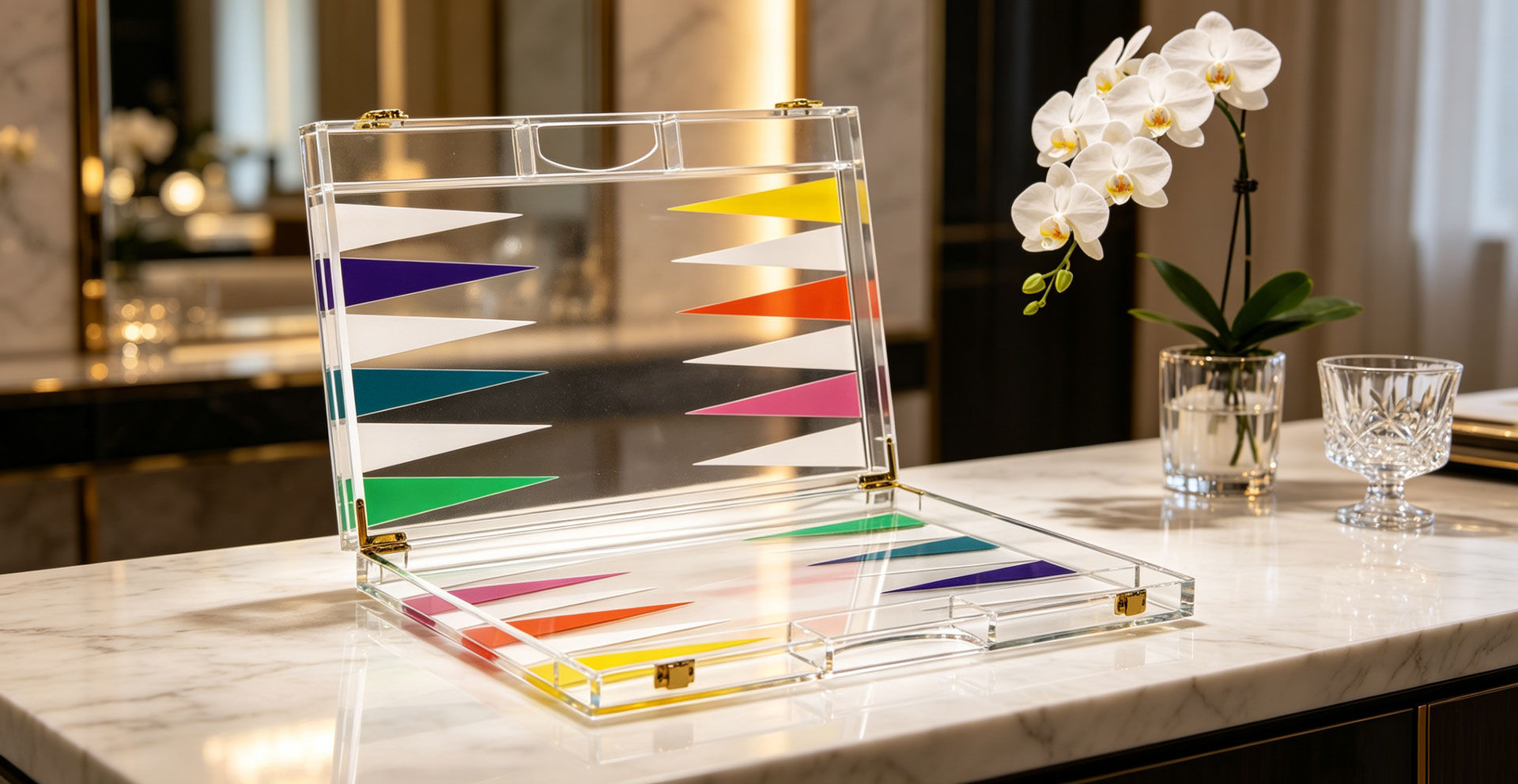
When a retailer or distributor decides to add bulk acrylic backgammon to their product catalog, the sourcing decision extends far beyond choosing a supplier name from a directory. You are evaluating production capacity, pricing tiers, lead time reliability, quality consistency across hundreds of units, and the logistics architecture that determines whether your first container arrives on schedule—or in pieces.
At JAYI Acrylic, our factory has produced over 300,000 acrylic board game units annually, with a dedicated workflow for custom acrylic backgammon set production that serves retailers and distributors across North America, Europe, and the Middle East. We have shipped bulk backgammon orders ranging from initial test runs to multi-container annual supply agreements. This article shares what experienced buyers consider before placing bulk orders, so you can approach your first procurement cycle—or optimize an existing one—with clarity.
Key Points:
• Bulk backgammon procurement involves five distinct decision areas: MOQ structure, pricing tiers, lead time planning, quality verification, and shipping optimization.
• Minimum order quantities vary by product configuration and customization scope—understanding where thresholds sit prevents costly under-ordering or over-commitment.
• Lead time planning for acrylic backgammon must account for sampling (3–7 days) and production (15–35 days), plus a buffer for quality inspection and freight scheduling.
• Container utilization and multi-SKU consolidation are two high-impact strategies that experienced buyers use to reduce per-unit landed costs.
• A structured procurement checklist aligned to factory capability data helps buyers separate credible manufacturers from resellers.
Why Bulk Acrylic Backgammon Demands a Different Sourcing Approach Than Small Orders
Placing a sample order of five or ten custom acrylic backgammon sets and placing a bulk order of 500 or 2,000 units are fundamentally different procurement exercises. Small orders test product quality and supplier responsiveness. Bulk orders test production consistency, cost architecture, logistics coordination, and your own inventory management discipline.
In small orders, minor quality deviations can be tolerated or corrected manually. In bulk runs, a 2–3% defect rate translates to 10–60 units that may not pass your retail standards. Small orders ship via express courier with minimal packaging complexity. Bulk orders require carton configuration, palletization, and container loading plans that impact your freight cost per unit.
Our experience shows that retailers who treat bulk backgammon procurement as an extension of their sample ordering process frequently encounter friction at the production stage—delayed timelines, unclear communication about scheduling, and surprise cost line items. The buyers who source most effectively approach bulk orders as structured procurement projects with defined parameters from day one.
This article walks through the five decision areas that shape a successful bulk backgammon procurement cycle, from understanding MOQ structures to optimizing your shipping configuration.
Understanding MOQ Structures and Volume Pricing for Acrylic Backgammon
What Is a Realistic MOQ for Bulk Acrylic Backgammon?
Minimum order quantity (MOQ) is the starting point of any bulk sourcing conversation. For standard-format acrylic backgammon sets without custom branding, many suppliers set MOQs between 50 and 200 units. When you introduce customization—Pantone color matching, custom logo printing, branded packaging, or non-standard board dimensions—the MOQ typically adjusts upward.
Our standard MOQ for acrylic backgammon is 50 units for solid-color configurations, with flexibility for branded runs starting at 100 units, depending on printing method complexity. We structure these tiers to give buyers a clear path from initial test orders to full-scale production runs.
Volume Pricing Tiers: How Per-Unit Costs Change Across Order Sizes
Buyers frequently assume that pricing is linear—that 1,000 units costs exactly ten times what 100 units cost. In reality, manufacturing economics create tiered pricing structures where per-unit costs drop significantly at key volume thresholds.
|
Order Quantity |
Typical Price Positioning |
Key Factor |
|
50–100 units |
Baseline / sample-production rate |
Set-up cost amortization begins |
|
200–500 units |
10–20% below baseline |
Raw material procurement efficiency |
|
500–1,000 units |
20–30% below baseline |
Production scheduling optimization |
|
1,000+ units |
30–40% below baseline |
Full production line allocation |
These figures are directional benchmarks. Actual pricing varies based on board dimensions, accessory configuration (dice, checkers, doubling cubes), printing method (screen print vs. UV digital vs. laser engrave), and packaging tier. When you send an inquiry, include your target quantity range—we will break down the cost structure so you can make an informed decision rather than a guess.
Hidden Variables That Affect Bulk Pricing
Two buyers requesting the same 500-unit order can receive different unit prices based on:
• Board thickness: Thicker acrylic sheets increase material cost but also improve board weight and durability perception.
• Interior components: Checkers and dice quality, fabric playing surfaces, and felt-lined interiors add cost per unit.
• Logo complexity: Single-color screen print costs less than multi-color or full-wrap UV digital printing.
• Packaging tier: Polybag packaging costs a fraction of rigid gift boxes or velvet-lined presentation cases.
Understanding these variables lets you calibrate your product specification against your retail price point before committing to a bulk order.
Lead Time Planning for Bulk Acrylic Backgammon Orders
The Two-Phase Production Timeline
Bulk acrylic backgammon production operates on a two-phase timeline that every buyer must plan around:
Phase 1 — Sampling (3–7 days)
Before bulk production begins, your supplier produces a pre-production sample that verifies material quality, dimensional accuracy, and print fidelity. This is not optional in a serious procurement relationship. Skipping samples to save time is a common source of costly bulk disappointments. Budget 3–7 days for sample approval cycles, including potential revision rounds.
Phase 2 — Mass Production (15–35 days)
Once the sample is approved, mass production begins. The 15–35 day window depends on the current factory scheduling load and order complexity. Our production planning team shares schedules that account for machine availability, workforce allocation, and QC queue positions. Orders exceeding 1,000 units may require extended production windows—we communicate this upfront during the inquiry stage.
Building a Procurement Calendar That Works
Experienced buyers align order placement with downstream shipping windows by working backward from their delivery deadline:
1. Target delivery date minus freight transit time = Latest warehouse arrival date
2. Latest warehouse arrival minus port/customs clearance (if applicable) = Latest port arrival date
3. Latest port arrival minus inland transport = Latest container pickup at origin
4. Latest pickup minus production window (15–35 days) = Latest sample approval date
5. Latest approval date minus sampling window (3–7 days) = Latest order placement date
Working backward is the most reliable way to avoid compressed timelines that lead to quality shortcuts or premium express freight charges.
Quality Consistency Across Large Production Runs
Why Large Runs Require Stricter QC Protocols
A single artisan hand-assembling a batch of 20 backgammon sets pays individual attention to each unit. A production line manufacturing 1,000 units operates differently—variation can emerge across shifts, material lots, and equipment settings. The question is not whether variation exists but whether your supplier's quality control system catches and corrects it before shipment.
Every bulk backgammon order undergoes 100% full inspection before packing. Our QC team checks board flatness, hinge function, checker weight and color consistency, dice dimensions, print registration accuracy, and packaging integrity. We do not operate on sampling inspection rates for finished goods. This full-inspection protocol is supported by our ISO 9001 quality management system and verified by third-party inspection clients, including SGS and TUV.
What to Request from Your Supplier Before Placing a Bulk Order
• Defect rate history: Ask for documented defect rates on comparable game product runs.
• Inspection protocol: Request the QC checklist applied to your order and confirm whether it is 100% full inspection or sampling-based.
• Third-party inspection option: Confirm whether your supplier accepts SGS, Bureau Veritas, or equivalent inspection agencies.
• Rejection and rework policy: Understand how defects are handled—whether units are corrected, replaced, or credited.
A supplier who cannot provide clear answers on QC protocols is passing inspection risk to you.
Shipping and Logistics Optimization for Bulk Backgammon Orders
Container Utilization: Getting the Most From Your Freight Budget
Shipping bulk acrylic backgammon typically moves via 20-foot or 40-foot ocean containers (LCL or FCL) for international buyers, or via truck/rail for regional distribution. The single most impactful decision you can make to reduce landed cost is to optimize how your units fill the container.
Standard 20-foot container accommodates approximately 400–600 backgammon sets in individual cartons (depending on board size and packaging configuration).A
40-foot container typically holds 800–1,200 sets.
This means a 500-unit order requires partial container allocation. Negotiate with your supplier about multi-SKU consolidation—combining your backgammon order with other acrylic game products (domino sets, chess sets, mahjong sets) in a single container. Consolidation reduces per-unit freight costs and simplifies customs documentation.
|
Configuration |
Estimated Units per 40ft Container |
Freight Cost per Unit (Indicative) |
|
Backgammon only, full container |
1,000–1,200 |
Baseline |
|
Backgammon + dominoes, shared container |
600–800 backgammon |
15–25% lower per unit |
|
Backgammon + chess, shared container |
500–700 backgammon |
10–20% lower per unit |
Discuss consolidation options with your supplier during the order planning phase. Rearranging the SKU mix after production begins creates scheduling complications.
Palletization and Carton Specifications
Your supplier should provide carton dimensions, units per carton, and gross weight per carton before production begins. This information serves two purposes: it lets you calculate container utilization and prepare warehouse capacity for your receiving team. Backgammon sets with rigid gift boxes are heavier and less stackable than sets with flat polybag packaging—factor this into your storage planning.
JAYI's Production Capacity for Bulk Acrylic Backgammon Orders
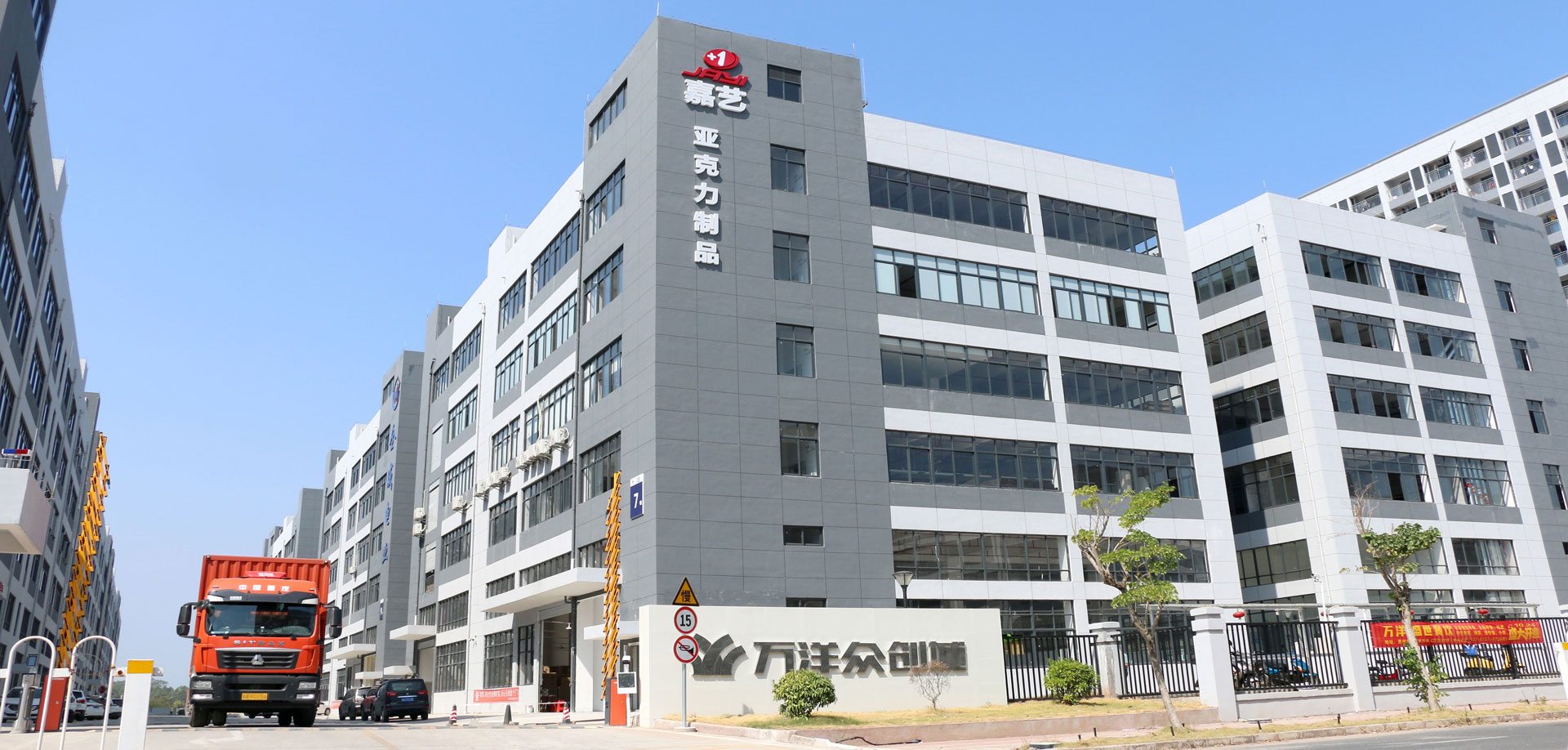
When you source bulk custom acrylic backgammon sets, you are not just buying a product—you are buying a manufacturer's ability to deliver it consistently across your program. JAYI Acrylic operates a 10,000㎡ self-owned facility, with over 95 production equipment units and a workforce of more than 150 employees, 80% of whom have been with us for over 10 years. Our factory has dedicated game product lines delivering over 300,000 units per year across mahjong, chess, dominoes, backgammon, and related acrylic board game categories.
This capacity translates to stable production scheduling, experienced operator continuity, and in-house finishing—from CNC cutting and diamond polishing to screen printing, laser engraving, and packaging—without splitting work across multiple vendors.
Our client portfolio includes Walmart, Target, and major luxury goods brands. If you are evaluating JAYI for acrylic backgammon sets for wholesale programs, we welcome structured inquiry conversations where you can review our capability documentation and production scheduling timelines.
Procurement Checklist — Sourcing Bulk Acrylic Backgammon for Retail
Use this checklist as your sourcing reference when evaluating suppliers and planning your order:
☐ Define order quantity and customization scope before sending inquiry—include board dimensions, material thickness, component specs, branding method, and packaging preference.
☐ Request MOQ breakdown by configuration (standard vs. custom-branded) to understand where your target quantity falls.
☐ Ask for volume pricing tiers with per-unit cost at each quantity threshold, not just a single price quote.
☐ Clarify lead time for both sampling (3–7 days) and mass production (15–35 days), and map these against your delivery window.
☐ Confirm QC protocol—100% full inspection vs. sampling inspection—and request documentation.
☐ Verify certifications relevant to your market: ISO 9001, SGS, BSCI, or others that matter for your retail channel.
☐ Request container utilization estimate for your order quantity and discuss multi-SKU consolidation if applicable.
☐ Get carton specifications (dimensions, units per carton, gross weight) for warehouse and logistics planning.
☐ Clarify payment terms: T/T, Trade Assurance, or other structures that align with your procurement policy.
☐ Obtain a pre-production sample before committing to full production—no exceptions for bulk orders.
FAQ
What is the typical minimum order quantity for bulk acrylic backgammon sets?
Standard-format acrylic backgammon sets without branding typically start at 50–100 units per order. Custom-branded runs, Pantone color matching, or non-standard board dimensions usually require 100–200 unit minimums. MOQ structures vary by supplier—request a breakdown specific to your configuration rather than relying on general benchmarks.
How does lead time for bulk acrylic backgammon compare to standard retail items?
Bulk lucite backgammon requires a two-phase timeline: 3–7 days for pre-production sampling and 15–35 days for mass production. Total procurement cycle from order placement to ready-to-ship typically spans 20–45 days, not including freight transit time. Buyers planning for retail floor dates should work backward from their delivery deadline using the calendar methodology described in this article.
What factors most affect the per-unit cost of bulk acrylic backgammon?
Order quantity and customization scope are the primary cost drivers. Logo printing method (screen print vs. UV digital), board thickness, interior component quality (dice, checkers, doubling cubes), and packaging tier (polybag vs. rigid gift box) each add or reduce per-unit cost. Board dimensions affect material yield and shipping density, which indirectly influence pricing.
Can I combine backgammon orders with other acrylic game products in one shipment?
Yes, and this is a recommended strategy for reducing per-unit freight costs. Multi-SKU consolidation—combining backgammon with domino sets, chess sets, or mahjong sets in a single container—typically reduces freight cost per unit by 10–25%. Discuss consolidation options with your supplier during the order planning phase, before production scheduling is finalized.
What quality control measures should a serious backgammon manufacturer implement?
A credible manufacturer should conduct 100% full inspection of all units before packing, supported by a documented QC checklist covering dimensional accuracy, material quality, hinge function, component completeness, and print fidelity. Inspections should be traceable with defect records. ISO 9001 certification indicates a structured quality management system; third-party inspection by SGS or TUV provides additional verification. Request this documentation during your supplier evaluation.
How do I evaluate whether a supplier's production capacity matches my order volume?
Ask suppliers for specific capacity metrics: square footage of manufacturing space, annual unit output for game products, number of production lines allocated to game categories, and current order queue status. A factory with proven annual output in the game category—300,000+ units per year, for instance—has the infrastructure, equipment, and workforce continuity to handle large bulk orders without compromising quality or delivery timelines.
Conclusion
Sourcing bulk acrylic backgammon for retail requires careful planning around MOQ, pricing, lead times, quality control, and logistics.
With clear procurement standards and JAYI’s stable production capacity, strict quality system, and full in-house manufacturing, you can secure a reliable, cost-effective supply that meets retail standards and supports long-term product success.

Cathy Qin
Cathy Qin works at Jayi Acrylic Industry Limited, focusing on custom acrylic game product management and SEO-driven content marketing for B2B wholesale and retail applications. Her work includes designing display solutions, managing customization projects, and optimizing website content to promote Jayi’s high-quality acrylic products across global digital channels.
Post time: May-21-2026