
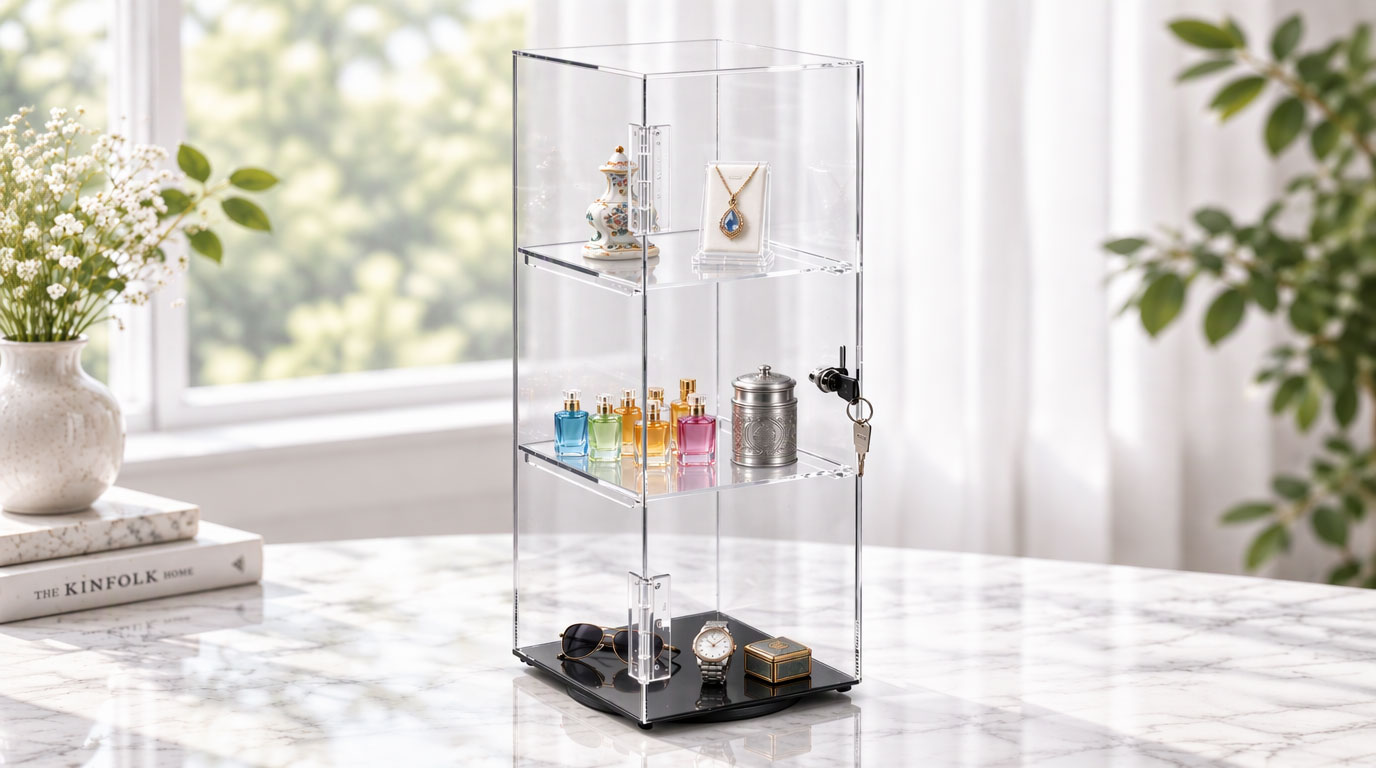
A lockable acrylic box is a clear PMMA container built with the lock as part of its structure — usually a cam lock, a keyed cabinet lock, or a padlock hasp — so valuable items can stay on public display and still be physically secure. Most buyers use them for retail counters, card and collectible storage, pharmacy and office shelving, and trade show showcases.
This guide covers the lock types that actually work on acrylic, the lid designs that pair with them, the material grades that stop a lock from cracking a panel, and the order details worth checking before you pay a deposit. If you are still comparing formats, our custom acrylic box page covers non-locking builds and sizing basics.
What Is a Lockable Acrylic Box?
A lockable acrylic box is a custom-fabricated clear box where the lock is designed into the panel or lid, not bolted on afterwards as an afterthought. The lid closes against a glued rim, and the lock holds the two parts together. Because acrylic is cut, milled, and glued rather than molded, the lock can sit almost anywhere — front panel, top lid, or side wall.
That flexibility is the real advantage. The lock can be placed exactly where your staff will reach it, and routed away from the product face so the display still looks clean from the customer's side.
Core Benefits of Lockable Custom Acrylic Containers
• Security without hiding the product. Clear walls on every side let staff watch the item while shoppers can still see it.
• Deterrence plus a real barrier. Most casual loss stops at the first locked case, because an open display becomes controlled access.
• Simple key control. One key per case, matched-key sets for multi-store rollouts, or a master key for managers.
• Dust, handling, and tamper evidence. A closed box keeps fingerprints, dust, and casual handling off the item.
• True fit. The box is built around your item, so there's no dead space, and nothing rattles in transit.
Common Lock Types for Acrylic Display Boxes
The lock you choose sets the panel thickness, the lid structure, and your repair plan. These five cover almost every order.
|
Lock type
|
Best for
|
What to know
|
|---|---|---|
|
Keyed cam lock
|
Jewelry, watches, small counter displays
|
Small flush footprint, fits a standard hole; matched or master keys available.
|
|
Keyed cabinet lock
|
Pharmacy, office, document and device storage
|
Longer bolt and stronger hold; the safer choice above 300mm.
|
|
Combination / dial lock
|
Shared-access displays, teaching labs
|
No key to lose and codes can be reset, but slower to open.
|
|
Padlock hasp
|
Crates, event and shipping cases
|
User supplies the padlock; the easiest part to replace on site.
|
|
Electronic / smart lock
|
High-value items, audit trails
|
Needs a battery hatch and a service plan; costs more and limits wall options.
|
Popular Design Options for Custom Acrylic Boxes with Locks
Lock first, lid second, branding last. Changing the lock later usually means re-cutting a panel, so settle that before anything else is quoted.
Size & Shape Customization
Custom lockable boxes run from 60mm ring cases to 900mm crates. A few rules of thumb keep the quote accurate:
• Internal size = item dimensions plus 5–10mm clearance on each side.
• Wall thickness of 3mm for small retail boxes, 5–8mm for counter displays, 10mm and up for vitrines and crates.
• Shapes include cube, rectangular, pyramid, hexagon, arch, and dome. All can carry a lock, but a curved lid needs a flat pad where the lock mounts.
Acrylic Material, Thickness and Finish Choices
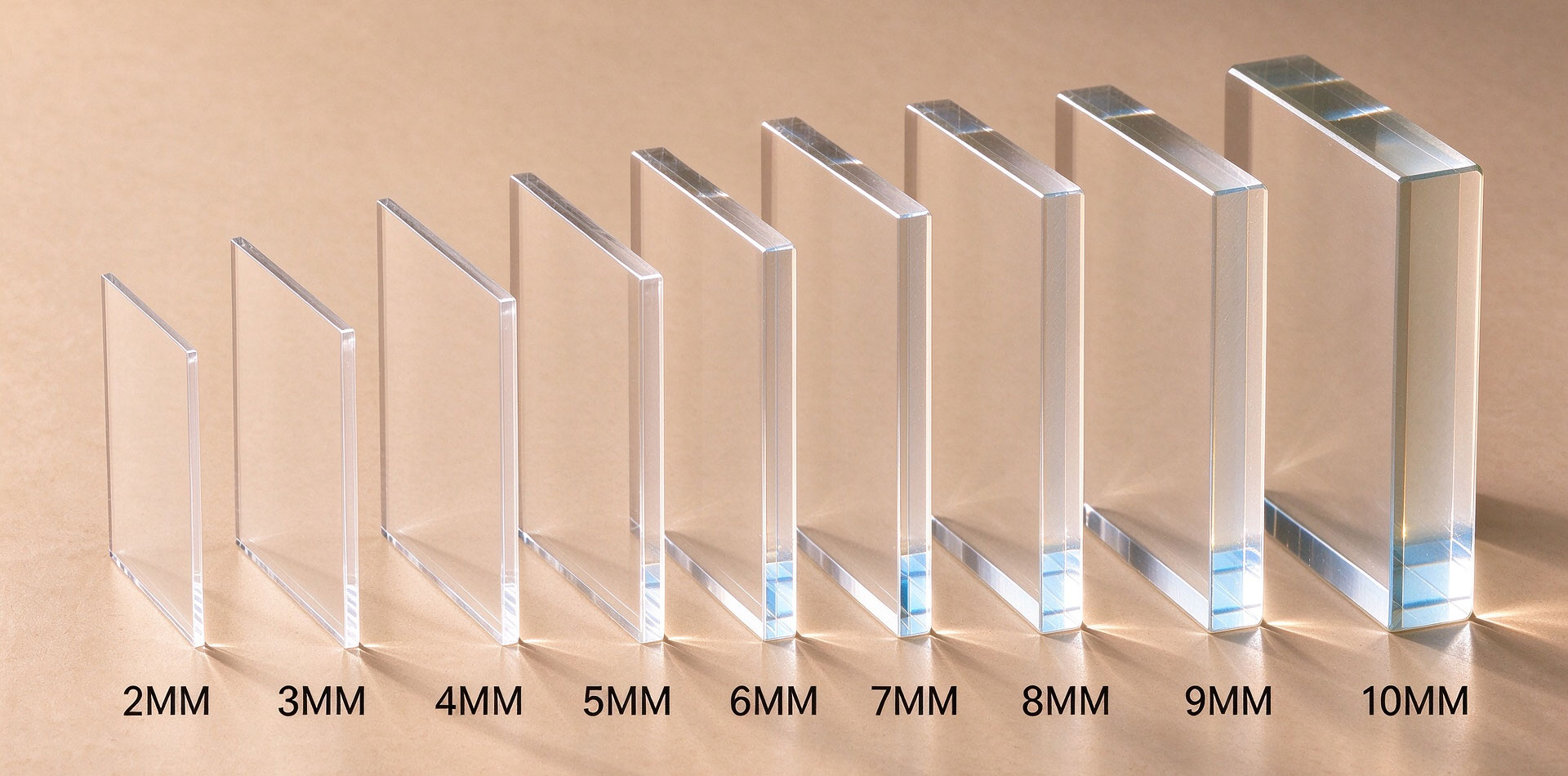
Material grade matters more on a locked box than on an open one, because drilling for a lock concentrates stress in one small area.
|
Wall thickness
|
Typical use
|
Lock compatibility
|
|---|---|---|
|
2–3 mm
|
Gift and small retail packaging
|
Light cam lock with a backing pad
|
|
4–5 mm
|
Jewelry, watch and card displays
|
Standard keyed cam lock
|
|
6–8 mm
|
Counter displays, larger boxes
|
Cam or cabinet lock, no pad needed
|
|
10 mm+
|
Museum vitrines, crates
|
Cabinet lock or padlock hasp
|
Cast versus extruded PMMA. Cast acrylic machines cleanly and resists crazing around a drilled lock hole. Extruded acrylic is cheaper but cracks more readily at drilled edges, so it suits small, lightly loaded boxes. It is worth asking which grade a quote is based on — it changes both price and service life.
Finish options are clear, frosted, tinted, mirrored, and hard-coated anti-scratch. A frosted band across the lock area is popular on locked retail boxes: it hides the hardware while keeping the product visible.
Engraving, Printing and Branding Customization
On a locked box, branding does double duty — it sells the product, and it marks ownership.
• Laser engraving for logos, serial numbers, and “property of” lines that pair naturally with key control.
• UV printing for multi-colour graphics, gradients and photographic logos.
• Silk screen for one or two spot colours at the lowest unit cost on long runs.
• Frosted or tinted zones as a softer way to place a logo without covering the product.
Lid Structure: Hinged, Slide, and Removable Tops
Three lid styles cover nearly every locked box, and each pairs with a different lock position.
|
Lid type
|
How the lock works
|
Best for
|
|---|---|---|
|
Hinged lid
|
Hinge on one edge, lock on the opposite edge
|
Counters opened dozens of times a day
|
|
Slide-in drawer
|
Front panel pulls out, lock holds it shut
|
Pharmacy, spare parts, stacked shelving
|
|
Removable top
|
Flat lid drops on, lock tab engages a front bracket
|
Crates, shipping and event use
|
|
Flip-top
|
Top panel tilts back, lock at the front edge
|
Compact boxes, jewelry and cards
|
Check the product page of the acrylic box with lid to learn more about the product.
Ready to Lock in a Design?
Send the item, the lock preference, and the quantity, and JAYI Acrylic will return a drawing and a factory price — no stock-box guessing.
Top Commercial Applications of Lockable Acrylic Boxes
A locked acrylic box shows up wherever an item has to be both visible and protected. These five are the highest-volume uses we quote.
Retail Display for High-Value Merchandise
Cosmetics, fragrance, small electronics, trading cards, and limited editions sit in a locked case on the counter. Staff carry one key; shoppers still see the whole product. The result is fewer open-box losses and far less “can I see that” traffic at busy times.
Museum, Gallery and Collectible Storage
Small artefacts, signed pieces, and graded collectibles use 8–10mm boxes with cabinet locks. Frosted or UV-filtering acrylic protects against light damage while the lock controls who handles the piece, which matters when visiting researchers share a study room.
Office & Pharmacy Secure Storage
Pharmacies, clinics, and offices use slide-drawer boxes for controlled stock, keys, devices, and confidential files. The lock keeps a defined list of people in, and the clear body lets a supervisor check stock at a glance without opening anything.
Trade Show and Exhibition Security Displays
Booths are crowded, and staff are distracted, which is exactly when samples disappear. A padlock hasp on a slightly larger box lets exhibitors lock overnight and swap the padlock between venues without reordering hardware.
Jewelry, Watch and Luxury Product Presentation
This is the classic build: 4–5mm cast acrylic, a flush keyed cam lock, a frosted logo band, and a hinged lid. The box often doubles as packaging, so both the lock and the finish are chosen to be seen, not just to secure.
For these builds, the custom acrylic box with lock product page lists the standard lock, hinge, and thickness combinations we keep ready to quote.
Key Factors to Consider Before Ordering Custom Lockable Acrylic Boxes
Most problems in this category come from four decisions made too late: security level, order quantity, certification, and packing.
Security Level Requirements for Your Items
Match the lock to the value and the exposure. A display opened fifty times a day needs a fast cam lock; a controlled-substance cabinet needs a cabinet lock with a longer bolt and a written key register. Decide who holds keys, how many copies exist, and what happens when one is lost before you approve production.
MOQ, Lead Time and Sample Policy
Typical factory terms for custom locked boxes look like this.
|
Stage
|
Typical range
|
What to confirm
|
|---|---|---|
|
Sampling
|
5–7 days
|
Hand-built sample, usually charged; ask if it is credited to bulk
|
|
Bulk production
|
15–25 days after sample approval
|
Longer for engraved or printed runs
|
|
MOQ
|
100 pcs standard displays; 300–500 pcs with engraving or printing
|
Lower on repeat orders of an existing size
|
Ask for a sample that carries the real lock, not a stand-in. A prototype with substituted hardware tells you nothing about the final fit or the key feel.
Compliance: SGS, REACH and Material Certifications
EU and US buyers increasingly ask for SGS reports and REACH compliance on the PMMA itself, plus documentation for any printed ink. Request the report before sampling, and check that it covers the exact grade being quoted, not a similar one. If the box is packaging for toys or children's items, ask separately about CPSIA and CPC requirements.
Packaging and Shipment Risk Notes
Acrylic scratches and cracks in transit are more common than most first-time buyers expect. Standard protection is PE film on both faces, foam or EPE wrap, an individual inner box, and a five-layer outer carton. Above 400mm, add corner protectors and ask for a stated drop-test rating on the carton.
FAQs About Custom Lockable Acrylic Boxes

Can I get a prototype sample before bulk production?
Yes, and you should. A factory sample takes about 5–7 days. Approve the real lock, hinge, and thickness on that sample before bulk starts; a prototype with substitute hardware proves nothing about the box you will actually receive.
Are the locks replaceable if damaged?
Yes, on most designs. Cam and cabinet locks are standard parts and can be swapped out with a screwdriver in minutes. Combination and smart locks are harder to service, so keep a spare lock set for retail rollouts and record serial numbers.
Can I mix different lock styles in one order?
Usually yes, within one size family. A cam lock and a cabinet lock use a similar hole, so mixing them is simple. Mixing a smart lock with a padlock hasp of the same size is not practical, because each needs a different panel layout.
Will a lock crack the acrylic over time?
Only if the panel is too thin or the material is extruded. A 4mm cast panel, a lock backing pad, and a cleanly drilled hole keep the joint stable for years. Thin extruded sheet and heat-damaged drilling are the two causes we see most.
What is the minimum order quantity?
100 pieces for standard display sizes, and 300–500 pieces once engraving or printing is involved. Repeat orders of an existing size usually start lower, so ask before assuming your volume is too small.
Conclusion: Get the Lock Right and the Box Follows
A lockable acrylic box is only as good as the three decisions behind it: the lock, the acrylic grade, and the fit.
Match the lock to how often the box is opened and who keeps the keys; specify cast PMMA at 4mm or more so the drilled hole stays stable, then size the box around the item instead of a stock mould.
Get those three right and a locked case stays clear, secure and serviceable for years.
Get Your Custom Lockable Acrylic Box Quote Today
Send a drawing, a photo of the item, or just its dimensions and the lock style you have in mind. JAYI Acrylic, a manufacturer with over 20 years in acrylic fabrication, returns a 3D mock-up, a material recommendation, and a factory quotation — usually within 24 hours.
Every quote is built on the real acrylic grade, the actual lock model, and the shipping carton, so the price you approve is the price you pay at the factory. Start with the custom acrylic box with lock range, or send your specifications directly to sales@jayiacrylic.com.

Cathy Qin works at Jayi Acrylic Industry Limited, focusing on custom acrylic product management and SEO-driven content marketing for B2B wholesale and retail applications. Her work includes designing display solutions, managing customization projects, and optimizing website content to promote Jayi’s high-quality acrylic products across global digital channels.