
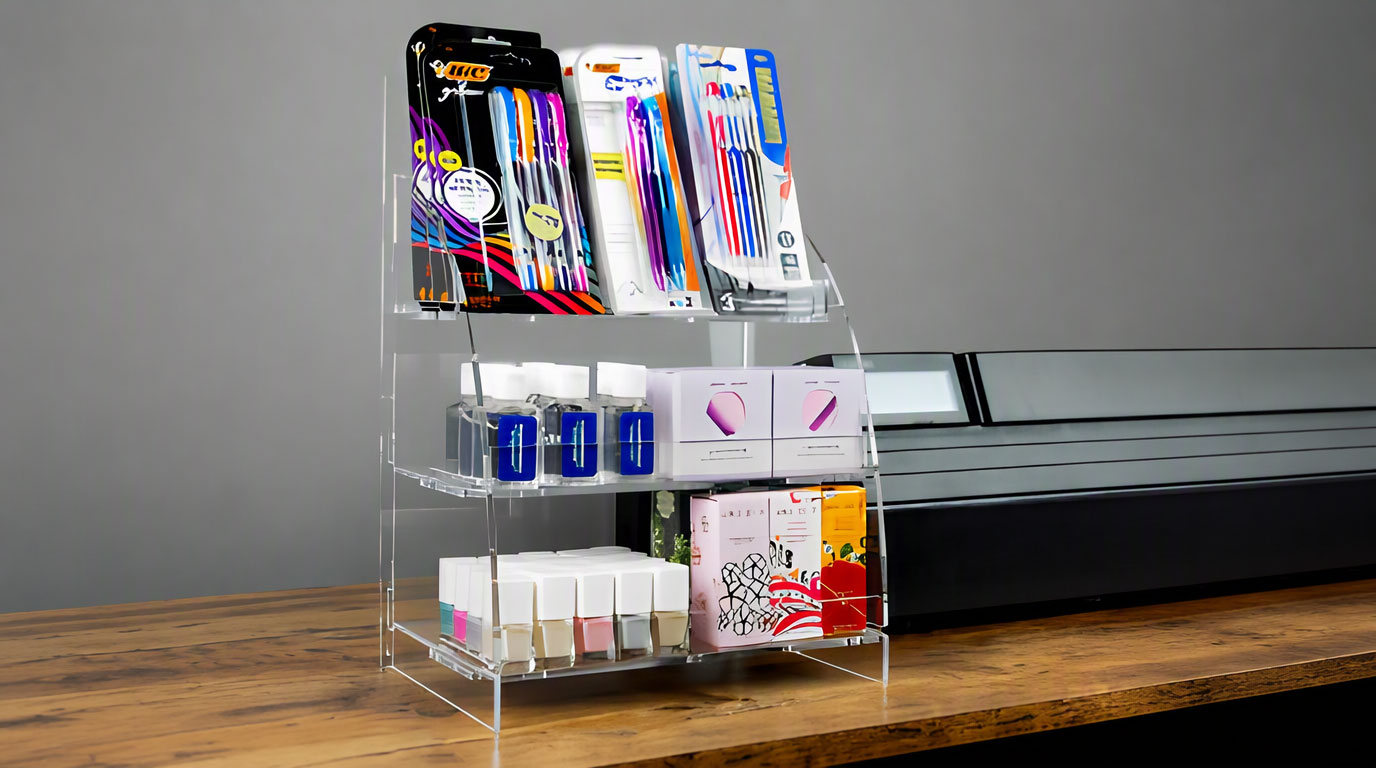
Picking the correct custom acrylic counter display size is one of the easiest ways to boost in-store sales and keep your retail counters neat and professional.
Many store owners make simple sizing mistakes that lead to amped layouts, wasted counter space, or displays that fail to showcase products well. This guide breaks down every practical step to measure, match, and confirm the ideal acrylic counter display size for any retail scenario.
Whether you sell cosmetics, accessories, or small luxury goods, you will learn actionable rules to avoid common errors and order a fully tailored display that fits your store perfectly.
What You’ll Learn in This Guide:
• Key pre-sizing factors that determine your ideal display dimensions
• Standard size categories for all custom retail acrylic display solutions
• Step-by-step measurement process for error-free customization
• Size matching tips for different retail product categories
• Answers to the most common buyer sizing FAQs
1. Why Size Matters for Custom Acrylic Counter Displays
1.1 Common Problems Caused by Wrong Display Sizes
Size is the foundation of a functional retail display. Even the highest-quality acrylic materials and stylish designs will fail if the size does not fit your actual counter and products.
An oversized custom acrylic counter display crowds your checkout counter, leaving no room for cash registers, packaging tools, or customer interaction. It makes your store look messy and unorganized, directly lowering the shopping experience.
On the other hand, a too-small display wastes valuable retail counter space. It cannot hold all your products, requires frequent restocking, and fails to create eye-catching visual merchandising effects.
Many retailers also face awkward issues like blocked customer views, unstable product placement, or mismatched store style due to improper sizing choices.
1.2 Core Benefits of Perfect-Sized Acrylic Counter Displays
Choosing the right acrylic counter display size brings tangible benefits for daily retail operations and sales performance.
First, it maximizes your limited counter space, ensuring every inch is used for product presentation instead of empty gaps or overcrowded layouts. Second, it keeps products neatly organized, making it easier for customers to browse and pick items quickly.
A well-sized custom retail acrylic display also creates a clean, high-end brand image. Transparent acrylic with a tailored size highlights product features without distracting customers, effectively boosting impulse purchases at checkout counters.
2. Key Pre-Sizing Factors to Consider First
2.1 Countertop Available Space & Layout Limitations
Your countertop space is the first non-negotiable factor for sizing. Before customizing, you must measure the usable area instead of relying on rough visual judgment.
Check for obstacles on your counter, such as card machines, receipt printers, shelf edges, or corner gaps. These small details will limit the maximum size of your display.
For narrow checkout counters, compact display sizes are always safer. For spacious retail counters, you can choose multi-layer structures to improve display capacity.
2.2 Product Type, Quantity and Dimension Specifications
Displays exist to showcase products, so your product size and stock quantity directly determine the ideal acrylic counter display size.
Tall products like perfume bottles need enough vertical height to avoid squeezing and scratching. Flat items like earrings and card accessories require wider horizontal space for full display.
If you need to place multiple product SKUs in one display, reserve separate zones for each category to avoid messy stacking and improve browsing efficiency.
2.3 Store Style, Customer Flow and Display Scenarios
High-traffic retail stores like convenience stores and beauty shops need practical, space-saving displays. A moderate size ensures customers can check out smoothly without crowding the counter.
Boutique stores with low customer flow can adopt slightly larger, more delicate displays to enhance the store’s aesthetic and high-end atmosphere.
You also need to distinguish between permanent counter displays and temporary promotional displays, as their sizing requirements are completely different.
2.4 Brand Merchandising & Visual Marketing Goals
If your goal is to promote new products or bestsellers, you need a display size that can highlight key items at the counter’s most visible position.
For brand image building, a tailored custom acrylic counter display with matched proportions unifies your in-store visual style and strengthens customer brand memory.
3. Standard Size Classification of Custom Acrylic Counter Displays
The following table summarizes common standard sizes and applicable scenarios to help you quickly locate your ideal display type:
|
Display Size Type
|
Common Dimension Range
|
Best Application Scenarios
|
|---|---|---|
|
Small-Sized
|
15–25cm (L) × 10–15cm (W) × 8–15cm (H)
|
Mini jewelry, earrings, lipsticks, single SKU promotion, narrow counters
|
|
Medium-Sized
|
25–40cm (L) × 15–25cm (W) × 15–30cm (H)
|
Cosmetics sets, phone accessories, candy samples, most retail counters
|
|
Large-Sized
|
40–60cm (L) × 25–35cm (W) × 30–50cm (H)
|
Multi-SKU display, bulk product placement, spacious boutique counters
|
3.1 Small-Sized Displays (For Mini Products & Limited Counter Space)
Small acrylic counter displays are compact, lightweight, and space-saving. They are perfect for stores with extremely limited counter space or brands that only need to display single promotional items.
These mini displays focus on product exposure, avoiding scattered placement of small items. They are widely used for jewelry, mini cosmetics, and portable electronic accessories.
3.2 Medium-Sized Displays (Most Versatile for Retail Countertops)
Medium size is the most popular option for custom retail acrylic display orders. It balances display capacity and space flexibility, fitting 90% of retail store counter layouts.
It supports single-layer and simple multi-layer structures, meeting the daily display needs of most beauty, gift, and convenience stores without occupying too much counter space.
3.3 Large-Sized Displays (For Bulk Product Display & High Exposure)
Large acrylic counter displays are designed for full counter merchandising. They can hold dozens of product SKUs and adopt tiered, partitioned, or combined structures.
They are ideal for boutique stores, brand flagship stores, and promotional event scenes that require high product display volume and strong visual impact.
4. Step-by-Step Guide to Determine the Exact Display Size
4.1 Measure Your Countertop Precisely (Tools & Measurement Tips)
Use a soft measuring tape or steel ruler to measure the length and width of your usable counter area. Avoid measuring the entire counter; ignore fixed equipment areas.
Measure twice to reduce errors, and record the minimum reserved space to ensure the display can be placed smoothly without edge collisions.
4.2 Calculate Product Placement Space (Single & Multi-Layer Layout)
Lay out all products to be displayed on the counter in advance. Simulate single-layer flat placement or multi-layer stacked placement modes.
Calculate the total occupied space of the products, and reserve independent space for each SKU to avoid extrusion and confusion.
4.3 Reserve Margins for Operation & Customer Viewing
Never customize a display that fills the entire counter. Reserve 3–5cm of blank space on all sides for daily cleaning and customer viewing.
Proper margins also prevent the display from looking crowded and ensure a comfortable visual experience for shoppers.
4.4 Match Size with Display Structure (Tiered, Stand, Pocket Style)
Tiered displays need extra vertical height to ensure each layer of products can be fully seen. Pocket-style displays require accurate width matching for product thickness.
Different structures have different size tolerance requirements, so confirm the structure first before finalizing the specific acrylic counter display size.
5. Size Matching Tips for Different Product Categories
5.1 Cosmetics & Skincare Products
Cosmetic products have diverse shapes, including tall bottles, flat boxes, and round jars. It is recommended to choose multi-layer, medium-sized displays with adjustable layer heights.
Reserve enough vertical space for tall perfume and lotion bottles to avoid tipping and scratching product packaging.
5.2 Electronics Accessories & Small Gadgets
Phone cases, data cables, and earphones are mostly flat and small. Partitioned small- and medium-sized displays are the best choice for classified placement.
Reasonable partition sizes can effectively prevent small accessories from mixing and improve customer selection efficiency.
5.3 Food, Candy & Beverage Samples
Snack and sample displays need wide horizontal space and load-bearing capacity. Medium to large flat displays are suitable for bulk placement.
Ensure the display size leaves enough gaps for customers to take items easily, which greatly improves the shopping experience.
5.4 Jewelry, Watch & Luxury Small Items
Luxury small items require a delicate and focused display. Small-sized tiered custom acrylic counter displays can highlight product texture and high-end positioning.
Avoid oversized displays that make high-value products look sparse and reduce the overall grade of the display.
6. Common Size Mistakes to Avoid When Customizing
6.1 Overlooking Counter Edge & Obstacle Space
Most buyers only measure the flat counter area but ignore protruding edges, sockets, and equipment corners. This leads to displays that cannot be placed normally after production.
6.2 Ignoring Product Height & Stacking Requirements
Many people only focus on length and width but ignore vertical height. Too-low layers will squeeze products, damage packaging, and affect display beauty.
6.3 Blindly Pursuing Large Size for More Display Space
Larger size does not mean a better display effect. Oversized displays will compress customer activity space, make the counter cluttered, and reduce the store's grade.
6.4 Neglecting Portability & Storage Size Needs
If you need to move or store displays regularly for promotional activities, overly large and fixed-size displays will cause great storage and transportation trouble.
FAQ

What is the most standard size for acrylic counter displays for retail stores?
The medium size of 25–40cm length, 15–25cm width, and 15–30cm height is the most standard and versatile size. It fits most retail checkout counters and meets the display needs of most daily products, making it the top choice for bulk custom retail acrylic display orders.
How much extra space should I reserve when customizing the display size?
It is recommended to reserve 3–5cm of blank space on each side of the display. This margin avoids a cramped layout, facilitates daily cleaning, reserves operating space for cashiers, and ensures customers have a comfortable viewing angle.
Can I adjust the size of an existing acrylic display design?
Yes. Professional acrylic manufacturers can flexibly adjust length, width, height, and layer spacing based on existing templates. Size adjustments will not affect the display’s overall structure and aesthetics, enabling fully personalized customization.
Does display size affect the cost and shipping fee of custom acrylic displays?
Absolutely. Larger custom acrylic counter display sizes require more acrylic raw materials, increasing production costs. Meanwhile, oversized packages will generate higher volumetric shipping fees, so reasonable sizing helps control overall procurement costs.
How to confirm if the customized size fits my counter and products before production?
You can provide counter and product measurement data to the manufacturer. Reliable factories will provide 2D design drawings and size simulation diagrams for confirmation before mass production, effectively avoiding size mismatch risks.
What size is suitable for multi-layer tiered acrylic counter displays?
Multi-layer tiered displays are recommended in medium size. The conventional layer height is 8–12cm, which adapts to most cosmetic and accessory products. Too small a size will make layering meaningless, while too large a size will cause top-heavy instability.
Conclusion
Choosing the right acrylic counter display size is not about pursuing a fixed standard, but about matching your store space, product characteristics, and marketing needs. A properly sized acrylic display can greatly optimize your in-store merchandising effect, tidy up counter layout, and drive more impulse sales.
Avoid blind customization and size mistakes that waste your budget and time. Take precise measurements, select the corresponding size type according to product categories, and reserve reasonable operating margins to ensure the display is both practical and beautiful.

If you are still confused about size selection or need professional customized solutions, turn to reliable acrylic display manufacturers. JAYI Acrylic, a professional custom acrylic display factory with years of customization experience, provides one-stop custom services for global retail buyers.
We offer free size consultation, professional design drawing confirmation, precise production, and strict quality inspection. Whether you need small promotional displays or large multi-layer retail displays, JAYI Acrylic can tailor the most suitable custom acrylic counter display solution for your brand, helping you upgrade your in-store display effect and brand image efficiently.

Cathy Qin works at Jayi Acrylic Industry Limited, focusing on custom acrylic product management and SEO-driven content marketing for B2B wholesale and retail applications. Her work includes designing display solutions, managing customization projects, and optimizing website content to promote Jayi’s high-quality acrylic products across global digital channels.
Post time: Sep-21-2026