
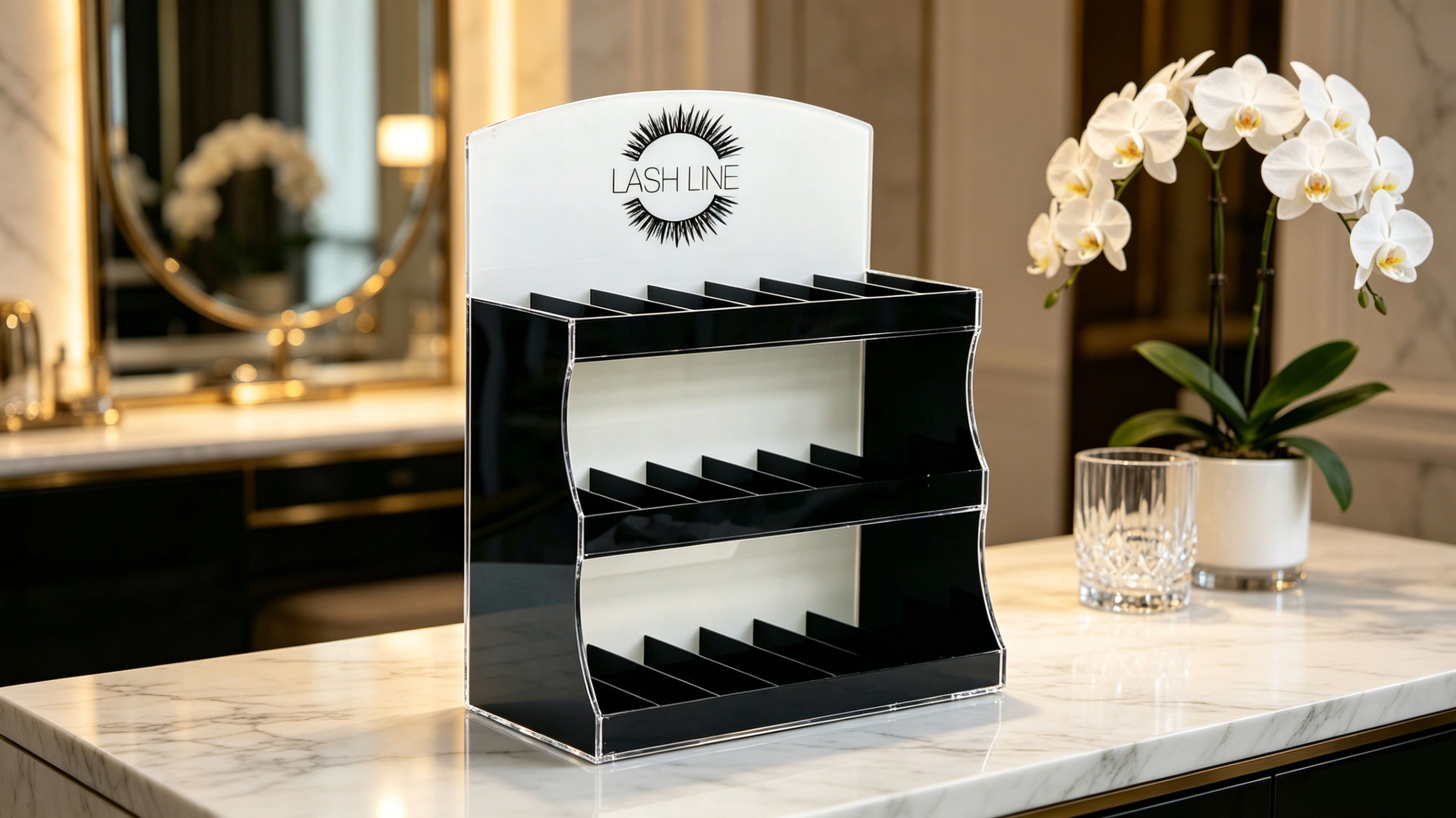
Custom acrylic displays have become the mainstream choice for retail cosmetics, jewelry shops, digital exhibitions, and commercial promotion events.
Most overseas buyers face selection confusion between OEM and ODM customization modes, which easily leads to overspent budgets, mismatched display styles, or a lack of brand uniqueness. Distinguishing these two B2B cooperation models is the key to cost control and efficient customization.
This article thoroughly breaks down their definitions, differences, pros and cons, helping you make precise purchasing decisions.
For the full production and customization system, check our complete resource: Custom Acrylic Displays Manufacturing Complete Guide.
Core Takeaways:
● ODM uses factory existing molds, ideal for low-budget and small-batch trial orders
● OEM supports full exclusive customization, perfect for long-term brand-differentiated display
● The two modes differ greatly in design rights, MOQ, cost, and production cycle
● Matching the right mode effectively avoids customization risks and resource waste
Why OEM & ODM Matter for Custom Acrylic Displays
Wide application scenarios of commercial acrylic displays
Acrylic display fixtures are widely used in modern commercial scenarios. They cover high-end cosmetic retail, luxury jewelry display, electronic product exhibition, and supermarket commodity sorting.
Compared with wood, metal, and plastic displays, acrylic features high transparency, strong plasticity, and a premium texture, greatly improving product display quality and customer shopping experience.
Key pre-customization demands for overseas buyers
Before starting any acrylic display customization project, buyers need to clarify basic core demands. These include display size, placement environment, target audience, and brand style positioning.
Unclear demand positioning often results in customized products that do not match store styles or usage scenarios, causing unnecessary cost losses and delivery delays.
Necessity of distinguishing OEM and ODM cooperation modes
OEM and ODM are the only two mainstream B2B customization modes for custom acrylic displays. Many purchasers mix up the two modes and make wrong order decisions.
Clarifying their essential differences in design independence, production rules, and service scope is the basic premise of efficient customization, accurate cost control, and risk avoidance.
What Is ODM Custom Acrylic Display? Definition & Core Features
Working principle of ODM customization
ODM stands for Original Design Manufacturer. Under the ODM model, the factory independently completes product design, mold development, and structural verification.
All mature acrylic display styles, layer structures, and standard sizes are developed and owned by the manufacturer. Buyers cannot change the core design framework freely.
Main service scope and production rules
ODM customization only allows partial modification based on the factory's existing finished molds. Common adjustable contents include logo printing, surface color, and partial size fine-tuning.
No new mold opening or structural redesign is required. The factory uses mature production lines for rapid mass production with stable quality and unified standards.
Target customers and applicable scenarios
ODM mode is mainly suitable for new startup brands, cross-border new sellers, and small-scale retail merchants. It is also ideal for temporary exhibition displays and short-term promotional activities.
Buyers with limited budgets, small order quantities, and no exclusive display style requirements can maximize cost performance through ODM cooperation.
What Is OEM Custom Acrylic Display? Definition & Core Features
Working principle of OEM customization
OEM means Original Equipment Manufacturer. Unlike ODM, OEM has no fixed factory design framework. The buyer fully dominates the entire product design scheme.
The factory only acts as a pure production processor, strictly manufacturing according to the buyer’s drawings, structural parameters, and customized standards.
Main service scope and production rules
OEM supports zero-restriction full customization, including exclusive shape design, personalized layered structure, custom thickness, and special edge treatment.
If there is no existing mold matching the design, the factory will open a brand-new exclusive mold for the buyer. All production details are completely customized according to brand demands.
Target customers and applicable scenarios
OEM mode targets mature brands, chain retail enterprises, and high-end gift customization companies. These buyers focus on brand image and market differentiation.
It is widely used in brand-exclusive offline stores, high-end exhibition booths, and long-term fixed commercial display scenarios requiring unique styles.
Core Differences Between OEM and ODM Acrylic Displays
The following comparison table intuitively shows the core differences between ODM and OEM acrylic display customization, helping you quickly screen suitable cooperation modes:
|
Comparison Item
|
ODM Customization
|
OEM Customization
|
|---|---|---|
|
Design Right Ownership
|
Owned by the factory, shared design
|
Owned by buyers, exclusive design
|
|
Customization Range
|
Only partial modification allowed
|
Full size, structure, and style customization
|
|
MOQ Standard
|
Low MOQ, support small batch
|
Higher MOQ for mold cost amortization
|
|
Production Cycle
|
Short, fast delivery
|
Longer, need design & mold opening
|
|
Unit Cost
|
Low, no extra development fee
|
Higher with exclusive development cost
|
Differences in design ownership and product uniqueness
ODM acrylic display designs belong to the manufacturer. The same style can be sold to multiple buyers, leading to homogeneous display effects in the market.
OEM designs are completely exclusive to buyers. Exclusive molds and customized structures ensure no identical styles in the market, highlighting brand uniqueness.
Differences in MOQ, cost and production cycle
ODM has almost no threshold for small-batch orders, with a low unit price and fast delivery speed. It has no additional mold opening or design labor costs.
OEM requires independent design verification and mold opening, so the early cost is higher, and the production cycle is longer, suitable for long-term bulk procurement.
Differences in customization flexibility and limitations
ODM can only adjust colors, logos, and individual sizes. The overall structure and layered style cannot be changed, with obvious customization limitations.
OEM has zero limitations in customization. Buyers can freely adjust thickness, radius, assembly structure, and surface technology to match brand positioning.
Pros & Cons of ODM Custom Acrylic Display Service
Key advantages of ODM cooperation
● Low trial cost: No design fee or mold fee, greatly reducing early procurement investment pressure
● Fast delivery speed: Ready-made molds skip development steps and support rapid mass production
● Low order threshold: Flexible MOQ adapts to small-batch trial sales and temporary display demands
Visible drawbacks of ODM customization
The biggest drawback of ODM is a lack of product uniqueness. The core style is shared by the industry, which cannot form exclusive brand display advantages.
The customization degree is low, and it cannot meet the personalized structural optimization needs of high-end brand stores and exclusive exhibition scenarios.
Best business scenarios to choose ODM
ODM is the best choice for new e-commerce sellers, seasonal promotional displays, and short-term exhibition activities. It is also suitable for buyers with insufficient budget and no fixed display VI system.
It helps buyers quickly complete market layout and verify product sales effects with minimal trial-and-error costs.
Pros & Cons of OEM Custom Acrylic Display Service
Key advantages of OEM cooperation
● Exclusive brand differentiation: 100% customized design avoids market homogenization competition
● Full scene adaptation: Free adjustment of structure and technology to fit all special display environments
● Long-term value accumulation: Exclusive molds and designs can be reused for repeated bulk orders
Visible drawbacks of OEM customization
OEM has a higher cooperation threshold, requiring buyers to provide complete design drawings or clear structural demands.
The one-time mold opening and design cost increase the early investment, and the overall production cycle is longer than the ODM mode.
Best business scenarios to choose OEM
OEM is suitable for mature chain brands, high-end cosmetics and jewelry merchants, and corporate gift customization enterprises.
It is the preferred solution for buyers who pursue long-term brand image building, an exclusive store style, and high-end display quality.
FAQ
Which is more cost-effective, OEM or ODM acrylic displays?
ODM is more cost-effective for small batches and short-term use. OEM has higher early costs but better long-term brand value for bulk repeated orders.
Can ODM acrylic display stands achieve exclusive brand styles?
No. ODM uses shared factory molds. Even with customized logos and colors, the overall structure remains the same as other merchants’ products.
Does OEM customization require ready-made design drawings?
Complete drawings are preferred. If not, our professional design team can sort out structural schemes according to your demand descriptions.
What are the MOQ differences between OEM and ODM orders?
ODM supports a low MOQ (50pcs) even for trial orders. OEM has a higher MOQ (100pcs) to amortize one-time mold opening and design costs.
Which mode is suitable for new sellers and small-batch trials?
ODM is the most suitable. It features low risk, low cost, and fast delivery, perfectly matching new sellers’ market trial demands.
Can I switch from ODM to OEM for subsequent bulk orders?
Yes. You can start with ODM trial sales and switch to exclusive OEM full customization after stabilizing market demand.
Conclusion
OEM and ODM are two indispensable customized cooperation modes in the acrylic display industry, with their own unique advantages and applicable scenarios. There is no absolute good or bad, only the most suitable choice for your business stage.
New sellers and temporary display demands prioritize ODM for cost efficiency and flexibility. Mature brands pursuing an exclusive image and long-term competitiveness must choose OEM full customization.
Clarifying the differences between the two modes can help every overseas buyer avoid customization pitfalls, control procurement costs, and obtain high-quality acrylic display solutions that match brand positioning.
As a reliable professional acrylic display manufacturer, JAYI Acrylic provides both OEM and ODM one-stop customization services for custom acrylic displays. With over 20 years of production experience, advanced processing equipment, and a strict quality control system, we support free sampling, flexible order rules, and global export services. Whether you need small-batch ODM trial products or large-scale exclusive OEM customized displays, JAYI Acrylic can provide cost-effective, high-quality, and compliant customized solutions for your brand.

Cathy Qin
Cathy Qin works at Jayi Acrylic Industry Limited, focusing on custom acrylic display product management and SEO-driven content marketing for B2B wholesale and retail applications. Her work includes designing display solutions, managing customization projects, and optimizing website content to promote Jayi’s high-quality acrylic products across global digital channels.
Post time: Jul-02-2026