
Choosing the right display fixture directly impacts your store’s presentation quality, operational cost, and on-site safety.
Most business buyers struggle to pick between an acrylic display box and a traditional glass showcase, as both deliver clear product display but differ hugely in practical use.
This display case material comparison breaks down real-world differences in cost, weight, safety, and daily usability to help you make a budget-friendly, risk-free decision.
Article Key Takeaways:
● Clear cost gap in initial purchase, shipping, and long-term maintenance
● Huge weight difference affects installation flexibility and venue adaptability
● Obvious safety gaps in breakage risk, especially for high-traffic public areas
● Suitable scenarios for each material to avoid overspending or safety hazards
1. Basic Overview: Acrylic Display Box vs Glass Showcase
1.1 What Is an Acrylic Display Box?
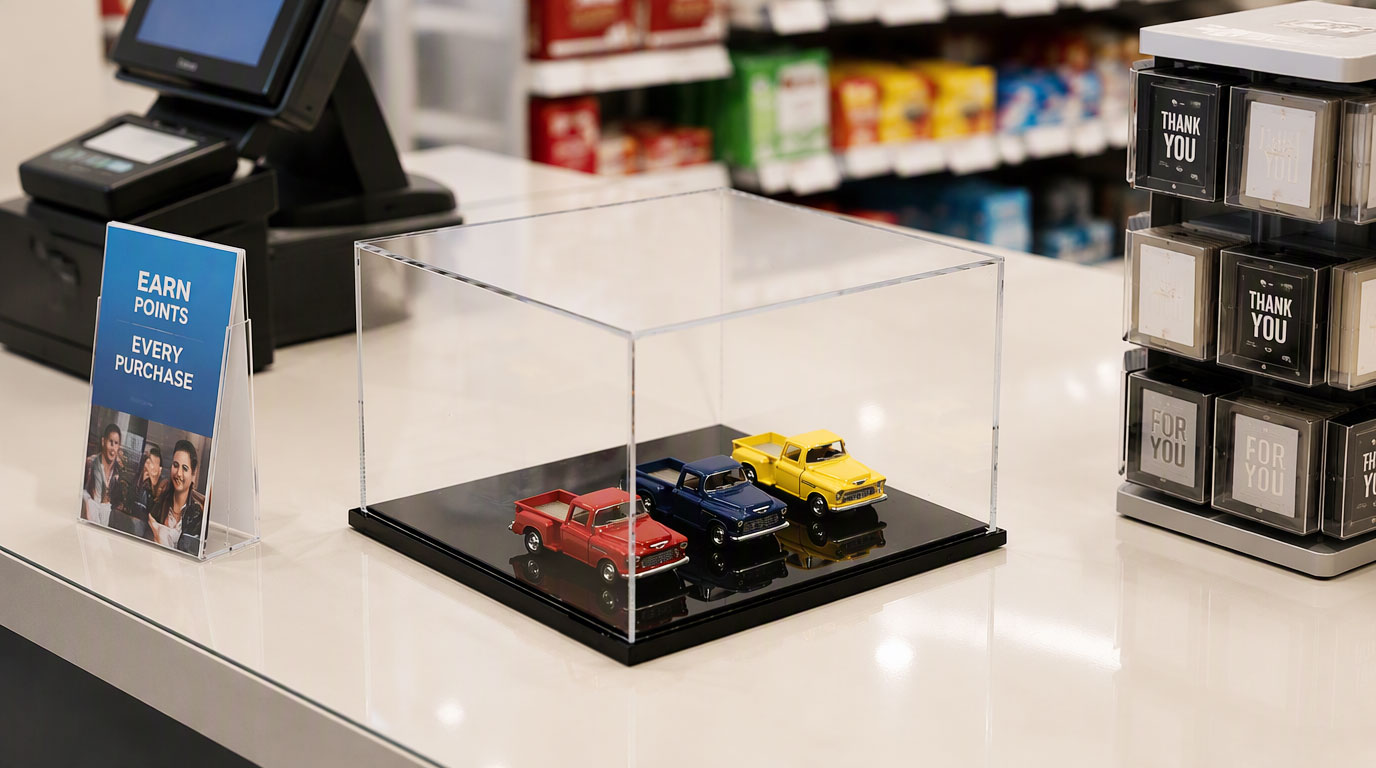
An acrylic display box is a transparent, lightweight display fixture made from PMMA plastic material. It features high clarity, good toughness and strong customization ability. Unlike rigid glass structures, acrylic boxes can be cut, bent and molded into various shapes to fit diverse display needs.
It is widely used for retail product display, collectible storage, exhibition booth display and mall pop-up displays. For businesses that need frequent layout adjustments, the acrylic display box is always a flexible and practical option.
1.2 What Is a Glass Showcase?
A glass showcase is a classic display unit built with tempered glass panels and metal or wooden frames. It delivers ultra-high transparency and a premium, high-end visual texture. Glass display units are standard in luxury retail, jewelry stores, museums, and fixed indoor exhibition spaces.
However, glass showcases come with obvious drawbacks. They are heavy, fragile, and require professional installation. Moving or replacing them often causes extra time and labor costs for merchants.
1.3 Core Material Difference
The essential difference lies in material toughness and physical properties. Acrylic is a flexible plastic with shatter-resistant performance, while glass is a rigid, brittle transparent material. This fundamental difference leads to all gaps in weight, safety, cost and durability.
2. Cost Comparison: One-Time & Long-Term Expense
2.1 Initial Purchase Cost
In general, standard acrylic display boxes have a lower unit price than tempered glass showcases. Simple-sized acrylic cases require no complex frame support, which greatly reduces production costs.
Glass showcases need thick tempered glass, reinforced frames and professional processing. The higher material and craft standards directly raise the wholesale price, especially for large-size display units.
2.2 Transportation & Installation Cost
Shipping cost is a key hidden expense for bulk buyers. Acrylic’s light weight cuts down freight fees significantly. It also avoids high breakage compensation rates during long-distance transportation.
Glass showcases need shockproof packaging, pallet fixation and dedicated shipping. They require 2–3 professional workers to finish installation, which adds extra labor expenses for each project.
2.3 Maintenance & Replacement Cost
Acrylic surfaces are easy to maintain. Minor scratches can be polished, and damaged panels can be replaced separately at low cost. Daily cleaning only needs soft cloth and mild detergent.
Once a glass panel breaks or cracks, the whole glass showcase needs overall replacement. The high cost of tempered glass and on-site installation makes long-term maintenance far more expensive.
2.4 Cost Comparison Table
|
Cost Item
|
Acrylic Display Box
|
Glass Showcase
|
|---|---|---|
|
Initial Purchase Price
|
Low to Medium
|
Medium to High
|
|
Shipping & Freight Fee
|
Low (Light Weight)
|
High (Heavy & Fragile)
|
|
Installation Labor Cost
|
Minimal / Self-install
|
High (Professional Required)
|
|
Daily Maintenance Cost
|
Very Low
|
Medium to High
|
3. Weight & Portability Comparison
3.1 Overall Weight Gap
Acrylic material is nearly 50% lighter than glass with the same thickness. A standard desktop display box can be easily lifted by one person. Even large floor-standing acrylic cases will not cause excessive pressure on floors and shelves.
Glass showcases are extremely heavy due to thick tempered glass and solid frames. Multiple units will bring heavy load pressure to indoor floors, which is not friendly for temporary venues and second-floor shops.
3.2 Suitability for Temporary Events
For pop-up stores, roadshows and temporary exhibitions, mobility is crucial. The acrylic display box can be disassembled, stacked and transported repeatedly without deformation or damage.
Glass showcases are fixed display facilities. They cannot be moved frequently. Frequent disassembly and transportation will greatly increase breakage risk and invisible loss.
3.3 Space & Installation Flexibility
Acrylic display boxes support flexible placement on counters, shelves and floors. They fit small shops, booths and compact display areas perfectly. Custom irregular sizes are also available.
Glass showcases rely on fixed support structures. They need stable ground space and reserved installation positions, which limits flexible layout adjustment for store upgrading.
4. Safety Performance Comparison
4.1 Breakage Resistance
Acrylic has excellent shatter-resistant performance. When impacted by external force, it will not break into sharp fragments. It only produces slight indentations or surface scratches, with an extremely low failure risk.
Tempered glass is hard but brittle. Once over-impacted, a glass showcase will burst into sharp broken pieces. Even qualified tempered glass still has hidden breakage risks in collision and falling scenarios.
4.2 Injury Risk for Public Scenarios
Shopping malls, children’s stores and exhibition centers have large pedestrian flow. In these public areas, broken glass may easily cause cuts and scratches to customers and staff.
The safe, non-shatter feature of acrylic display boxes eliminates personal injury risks. It is the preferred safe display solution for high-foot-traffic commercial environments.
4.3 Environmental & Fire Safety
High-quality acrylic materials adopt safe formula with low volatility and no toxic odor. They are stable at normal indoor temperatures and will not deform or release harmful substances.
Glass is chemically stable and fire-resistant, but its safety advantage is limited. It cannot resist impact damage, which is the most common safety accident in daily display scenarios.
5. Additional Performance Comparison
5.1 Display Visual Effect
High-transparency acrylic achieves over 90% light transmittance, presenting clear and bright display effects. It is slightly less crystal-clear than ultra-clear glass, but the visual gap is negligible for most retail scenarios.
Glass showcases deliver superior high-end texture and ultra-clear vision. They are more suitable for luxury goods, high-end jewelry, and museum cultural relic displays that pursue top-grade display effects.
5.2 Durability & Scratch Resistance
Ordinary acrylic is slightly prone to scratches, but upgraded hard-coated acrylic effectively improves scratch resistance. Daily contact and wiping will not cause obvious wear.
Glass has hard surface and strong scratch resistance, but its fatal flaw is fragility. Durability depends entirely on avoiding collision, which is hard to control in commercial environments.
5.3 Customization Flexibility
Acrylic processing is flexible. Factories can customize any size, shape, color and printed logo according to buyer needs. Small batch personalized orders are also acceptable with low MOQ.
Glass showcase customization is limited by cutting and tempering technology. Special-shaped and ultra-large size customization has high difficulty, long lead time and higher cost.
6. Suitable Scenarios for Each Display Case
6.1 Best Scenarios for Acrylic Display Boxes
● Retail store daily product display and commodity classification display
● Pop-up exhibitions, temporary booths and mobile display activities
● Children’s zones, supermarkets and high-traffic public areas
● Collectible, toy and small gift product storage and display
● Buyers with limited budget and frequent layout adjustment needs
6.2 Best Scenarios for Glass Showcases
● High-end jewelry stores, watch shops and luxury brand retail
● Museums, art galleries and formal exhibition halls
● Fixed store decoration with no frequent movement demand
● Scenarios pursuing ultimate high-grade display texture
7. FAQ

Which is more cost-effective for long-term bulk purchase, acrylic or glass display boxes?
For most commercial bulk orders, acrylic display boxes bring better overall cost performance. They have lower purchase and shipping costs, plus minimal maintenance loss. Glass showcases are only cost-effective for fixed high-end stores with no frequent replacement needs.
Are acrylic display boxes safe enough for shopping mall public display?
Yes. Shatter-resistant acrylic material avoids sharp fragment injury risks, which fully meets mall public safety standards. Compared with fragile glass showcases, acrylic is more suitable for crowded commercial public areas.
Does acrylic material affect the display effect of high-end products?
Hard-coated high-transparent acrylic has extremely high light transmittance, with almost no visual difference from ordinary glass. It can fully show the details and texture of jewelry, cosmetics and collectibles, totally meeting mid-to-high-end display needs.
Which one is easier to maintain and clean in daily use?
Acrylic display boxes are much easier to maintain. You only need a soft microfiber cloth and clean water for daily wiping. Glass surfaces are easy to leave water marks and dust, and broken glass replacement is far more troublesome.
Can acrylic display boxes be customized in special sizes and shapes like glass showcases?
Acrylic supports richer customization than glass. It can be made into arc, round, irregular and ultra-thin special shapes, with printed logos and frosted effects. Custom lead time is shorter and cost is lower than glass showcase customization.
What is the service life difference between acrylic and glass display cases?
With proper maintenance, high-quality acrylic display boxes can serve 5–8 years. Glass showcases have longer theoretical life, but accidental collision damage often shortens their actual service life. In practical business use, acrylic has more stable long-term service performance.
Conclusion
This display case material comparison clearly proves that acrylic display boxes and glass showcases have their unique strengths. Glass occupies advantages in high-end display texture, while acrylic wins in cost control, portability and public safety.
For most retail, exhibition and commercial scenarios, the lightweight, safe and low-cost acrylic display box is the more practical choice. For fixed high-end brand stores, a classicglass showcase can better enhance product grade.
When purchasing in bulk, do not only focus on unit price. comprehensively consider shipping, safety and maintenance costs to select the most suitable display solution for your business.

If you are looking for stable-quality custom acrylic display cases for bulk purchase, JAYI Acrylic is a professional and reliable factory supplier. Focusing on acrylic display box production for years, JAYI Acrylic provides one-stop services including custom size, logo printing, surface hardening treatment and global shipping.
Different from trading companies, JAYI Acrylic has independent production workshops and strict quality inspection standards. It can effectively control product transparency, scratch resistance and safety performance, helping global buyers get cost-effective, long-lasting display fixtures.

Cathy Qin works at Jayi Acrylic Industry Limited, focusing on custom acrylic product management and SEO-driven content marketing for B2B wholesale and retail applications. Her work includes designing display solutions, managing customization projects, and optimizing website content to promote Jayi’s high-quality acrylic products across global digital channels.